Can-Am Ryker Scorpio Custom Inflatable Scorpion Sculpture
Project Details
Client
BRP Can-Am Ryker
Type
Giant Outdoor / Art / Simulated Animal
Application
Commercial Advertising / Brand Marketing Campaign
Size
7 meters long
Material
Oxford Fabric / Hot-stamped Silver Fabric / PU
Craft
Heat Transfer Printing / 3D Modeling & Pattern Making / Laser Cutting
Video
Story
When a 7-Meter Scorpion Climbs a Vertical Wall | 360 Inflatable Partners with Can-Am Ryker to Create a High-Impact Brand Visual Installation
BRP Can-Am Ryker Scorpion Large-Scale Inflatable Installation Project Case Study

For an international powersports brand like Can-Am Ryker, a visual installation at an offline event is about far more than simply making something large enough to attract attention.
It needs to capture attention immediately while conveying the brand’s identity accurately. It must work within the visual composition of the event space while also ensuring that the large-scale installation remains stable and performs reliably in a real-world environment. In particular, when a 7-meter-tall scorpion figure needs to be installed against an almost vertical branded backdrop, the real challenge goes beyond reproducing the shape. It requires comprehensive capabilities covering design, load distribution, fixing methods, and on-site execution.
For this project, Wenzhou 360 Inflatable worked closely with BRP Can-Am Ryker, collaborating on the creation of this highly impactful scorpion-themed inflatable installation for a brand activation.
For 360 Inflatable, this was more than simply manufacturing a large inflatable product. It was a complete exercise in brand IP reproduction, spatial presentation, and engineering execution.

From Brand IP to On-Site Installation: It Wasn't Just About Making a “Scorpion,” but About Capturing the Brand's Character
Can-Am Ryker has a highly distinctive visual identity and brand language.
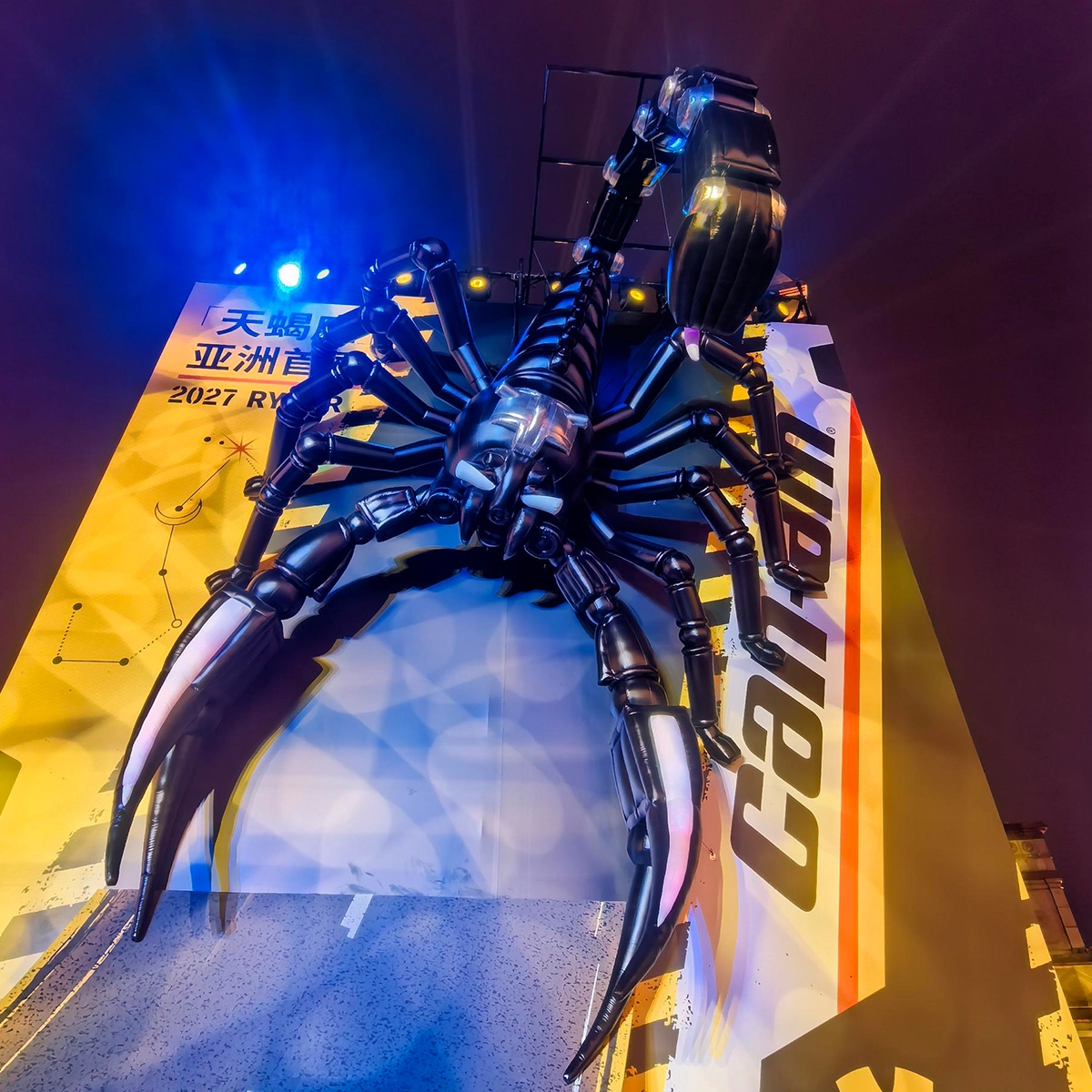
For this project, the scorpion character was not treated as a simple cartoon-style figure. Instead, its visual features were carefully translated into a three-dimensional form, reproducing the layered armor, articulated legs, curved tail, distinctive pincers, and tail stinger of the scorpion. This gave the entire installation a stronger sense of mechanical structure and aggressive energy in the nighttime lighting environment.
With a final height of approximately 7 meters, the installation was large enough to become a powerful visual landmark.
Especially under nighttime conditions, the black body created a strong contrast with the surrounding lighting. The scorpion appeared to emerge directly from the branded backdrop, creating a highly dynamic and visually striking effect.
This was the first major challenge that 360 Inflatable needed to address:
How do you transform a two-dimensional brand IP into a three-dimensional installation with real volume, depth, and visual impact?

The Real Challenge Wasn't “How Big?” but “How Do We Keep It Securely in Place?”
One issue is often overlooked in large-scale inflatable projects:
Being able to inflate an installation does not automatically mean that it can be presented stably on site.
This project made that challenge particularly clear.
For a conventional ground-mounted inflatable installation, stability can usually be addressed through base weights and ground anchoring.
But the Can-Am Ryker scorpion was not simply placed on the ground. Instead, it was integrated with a vertical branded backdrop to create a more dimensional presentation.
That transformed what would normally be a ground-support problem into a much more complex vertical installation and load-distribution challenge.
If the fixing system is not properly designed, the installation can be affected by its own weight, inflated condition, and environmental factors, potentially resulting in concentrated stress at specific points, positional shifts, or a compromised overall visual effect.
Therefore, throughout the project, 360 Inflatable did not limit its focus to whether the shape looked accurate. The team also considered the installation requirements from the perspective of the final on-site presentation, developing a fixing and load-bearing approach tailored to the actual application.

So How Does a 7-Meter “Scorpion” Attach to a Wall? It Comes Down to a Complete Fixing Strategy
One of the most interesting questions people naturally have when they see the final installation is:
How can such a large scorpion “climb” a vertical branded wall?
This was one of the more intriguing details of the project.
Vertical installation of a large inflatable is not as simple as “tying a rope around the outside.”
During the early structural design stage, the team needed to consider the positions of the fixing points, the overall center of gravity, the load distribution across different sections, and the types of connection points that the on-site structure could provide.
For this reason, 360 Inflatable incorporated the fixing requirements into the product structure from the beginning. By applying a multi-point fixing approach, the load could be distributed across multiple locations rather than concentrated at a single point.
During installation, the inflatable was then connected to the existing background structure according to the actual site conditions, allowing the 7-meter-tall main body to maintain a stable display position.
The goal was not simply to make sure that the installation would “stay up.” It was to ensure that the inflatable would maintain the visual proportions and overall posture intended in the original design.
Because for a brand activation, even a slight shift, sagging, or change in angle can affect the final visual effect, no matter how precisely the inflatable itself has been manufactured.
For a professionally executed inflatable project, structural stability is part of the visual experience itself.

From “Inflatable” to a True Brand Installation
Another challenge was overcoming the traditional impression that inflatable products can look relatively “soft” or lightweight.
The Can-Am Ryker brand has a much stronger visual character associated with machinery, power, and motion.
Accordingly, the entire production process focused on preserving that character through both structural definition and visual detailing.
The scorpion's body was divided into numerous structural sections, creating clear dimensional relationships between the body, legs, tail, pincers, and other major components.
Certain sections were independently shaped to enhance depth and definition. In particular, the tail and pincers are among the most recognizable features of the scorpion, so the production process needed to ensure not only accurate proportions but also a strong sense of movement once inflated.
The final result looked less like a conventional “inflatable mascot” and more like a large-scale brand-themed art installation.

Once the Night Lighting Came On, the Scorpion Truly Came Alive
There was another particularly interesting detail to this project.
During the day, it appeared as a massive black scorpion.
But once night fell and the event lighting came on, its visual presence changed dramatically.
With integrated lighting illuminating selected areas, the different structural sections of the scorpion became more defined. The tail, pincers, and body details stood out more clearly against the surrounding environment.
The contrast between the black main body and the blue and yellow event lighting created a strong visual signature, making the installation highly recognizable even from a distance.
This is exactly what a successful brand installation should achieve:
It should not simply occupy a space. It should become part of the environment—a visual focal point that encourages people to stop, photograph, and talk about it.

Behind the 7-Meter Scale Is a Demanding Test of Manufacturing Precision and Structural Consistency
A large-scale inflatable measuring around 7 meters requires a completely different manufacturing approach from a conventional small inflatable product.
The larger the installation, the more easily small inconsistencies become visible.
A minor proportional deviation may be difficult to notice on a small product, but once the overall height reaches 7 meters, even small inaccuracies can become visually amplified.
For this reason, every stage—from structural segmentation and pattern development to sewing, assembly, and full inflation testing—needed to be evaluated against the final three-dimensional appearance.
The finished installation consisted of 1,612 cut panels, reflecting the complexity of the overall structure.
For 360 Inflatable, however, the key point was not simply the number of panels involved. What mattered was ensuring that all of those individual components ultimately came together as one cohesive and accurate representation of the brand IP.
This is one of the core capabilities required for large-scale IP inflatable projects:
It is not enough to make every individual component correctly; all of those components must ultimately become one complete visual identity.

One Blower Supports More Than Just the Volume of the Installation
This project uses an integrated 720W blower.
For a large-scale inflatable installation, the blower is not merely a device that makes the product “inflate.” It is an essential part of the system that keeps the structure continuously inflated and maintains its intended form.
This is especially important for a project designed for long-term display and vertical installation, where maintaining stable internal pressure directly affects the final visual performance.
When the inflation pressure remains stable, the scorpion's body, legs, tail, and other structural elements can retain a fuller three-dimensional form, allowing the brand visual to remain consistent throughout the display period.
A mature large-scale inflatable project therefore requires close coordination between structural design, visual form, blower configuration, and on-site installation.

From a Single Project to a Trusted Long-Term Inflatable Partner
For a brand, choosing an inflatable supplier is not simply a matter of comparing product prices.
What truly determines the final outcome is whether the supplier can understand the brand's requirements, translate creative visuals into an executable physical installation, and quickly develop practical solutions when real-world site conditions introduce new challenges.
In this Can-Am Ryker scorpion project, Wenzhou 360 Inflatable's role went far beyond product manufacturing.
From understanding the brand IP and developing the three-dimensional structure, to manufacturing the large-scale inflatable, considering the vertical installation strategy, configuring the internal blower system, and coordinating with the final lighting and spatial environment, 360 Inflatable remained focused on the brand's overall presentation throughout the project.
This is also the type of partnership that 360 Inflatable aims to build:
Not a one-off product supply relationship, but a long-term collaboration in which we become deeply involved in the execution of brand visual installations—from understanding the brand's needs to bringing them to life in real-world environments.
For an international powersports brand like BRP Can-Am Ryker, every offline brand activation requires a presentation that is stable, accurate, and visually impactful.
For Wenzhou 360 Inflatable, becoming a trusted inflatable partner means doing more than simply “making a good inflatable.” It means truly understanding the brand, the environment, the project, and the communication objectives behind every offline activation.

From One Scorpion to More Possibilities for Brand-Themed Spaces
Today, what visitors see is a powerful 7-meter scorpion standing out at an event venue.
But before it appeared on site, it had already gone through an entire process—from IP interpretation and structural design to manufacturing, fixing, installation, and final presentation.
That is where the real value of a large-scale brand inflatable lies:
It is not simply about reproducing an image. It is about transforming a brand's visual symbol into a three-dimensional experience that can enter a real environment, be seen, photographed, and shared.
This in-depth collaboration with BRP Can-Am Ryker represents another practical example of Wenzhou 360 Inflatable's capabilities in the field of branded thematic installations.
Moving forward, 360 Inflatable will continue to focus on large-scale custom inflatables while becoming more deeply involved in brand offline marketing activations, themed installation customization, and immersive visual experiences for commercial spaces—bringing more IP characters and brand concepts from two-dimensional visuals into real-world environments.
Make the brand visible. And make it memorable on site.