Inflatable Tube Man Buyer's Guide: Sizes, Blowers, Fabrics, and Custom Options
Every roadside business competes for the same three seconds of driver attention. Static banners blend into the visual noise, while an inflatable tube man cuts through it with height, color, and constant motion. Yet most first-time buyers order the wrong size, forget the blower, or choose a fabric that fades within a season, and the display meant to pull customers in ends up as an expensive lawn ornament.
An inflatable tube man is a lightweight fabric figure mounted on a continuous-output electric blower. As air moves up through the body and escapes through the arms and head, the figure bends, rises, and waves in unpredictable patterns. You may also see it called an air dancer or sky dancer; the product is the same. This guide covers every decision that separates a tube man that pays for itself from one that collects dust: sizes, blowers, fabrics, printing, and the questions to ask before you send a purchase order.
How Does an Inflatable Tube Man Work?
The dance looks random, but it is engineered. A continuous blower at the base forces high-velocity air up through the tube. The arm sections are built with a calculated air-pressure imbalance: air escapes faster from one side than the other, so each arm whips in an unpredictable pattern. Low-cost builds use symmetric arms that flop in a repetitive arc. Quality builds use engineered asymmetry, which produces the flailing motion that peripheral vision cannot ignore.
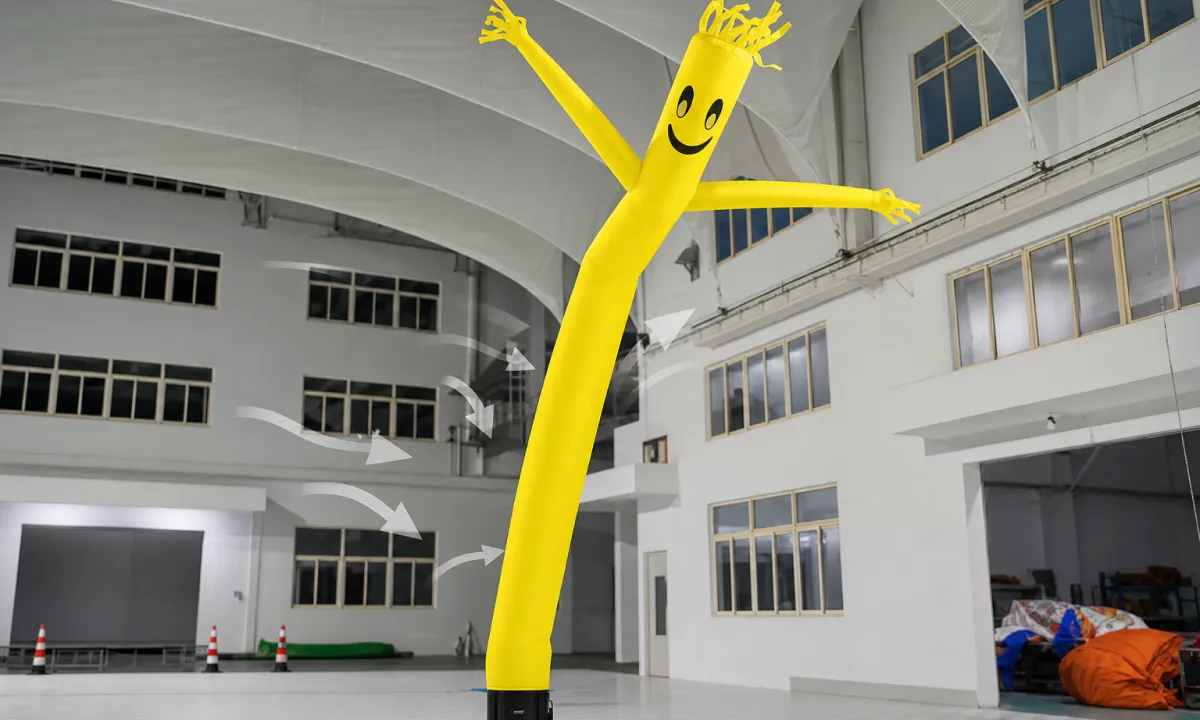
Four zones do the work. The base section locks onto the blower and holds the primary air pressure. The body tube channels airflow upward. The arm sections create the motion. The head zone carries the face or brand element at lower pressure. Movement is the whole value of the format: a static sign asks for attention, while a dancing figure takes it. That is why giant inflatable advertising keeps outperforming fixed signage in roadside visibility.
What Are the Main Types of Inflatable Tube Man?
Four formats cover nearly every commercial use case:
| Type | Typical Height | Print Surface | Best For |
|---|---|---|---|
| Classic single-leg | 6–20 ft | Full body | Retail storefronts, dealerships, grand openings |
| Double-leg | 15–25 ft | Body and legs | Large lots, stadium promotions, long-distance visibility |
| Custom-shape / mascot | 6 ft–20 m+ | Full character surface | Brand activations, IP campaigns |
| LED-integrated | 10–20 ft | Full body, backlit | Night events, evening retail hours |
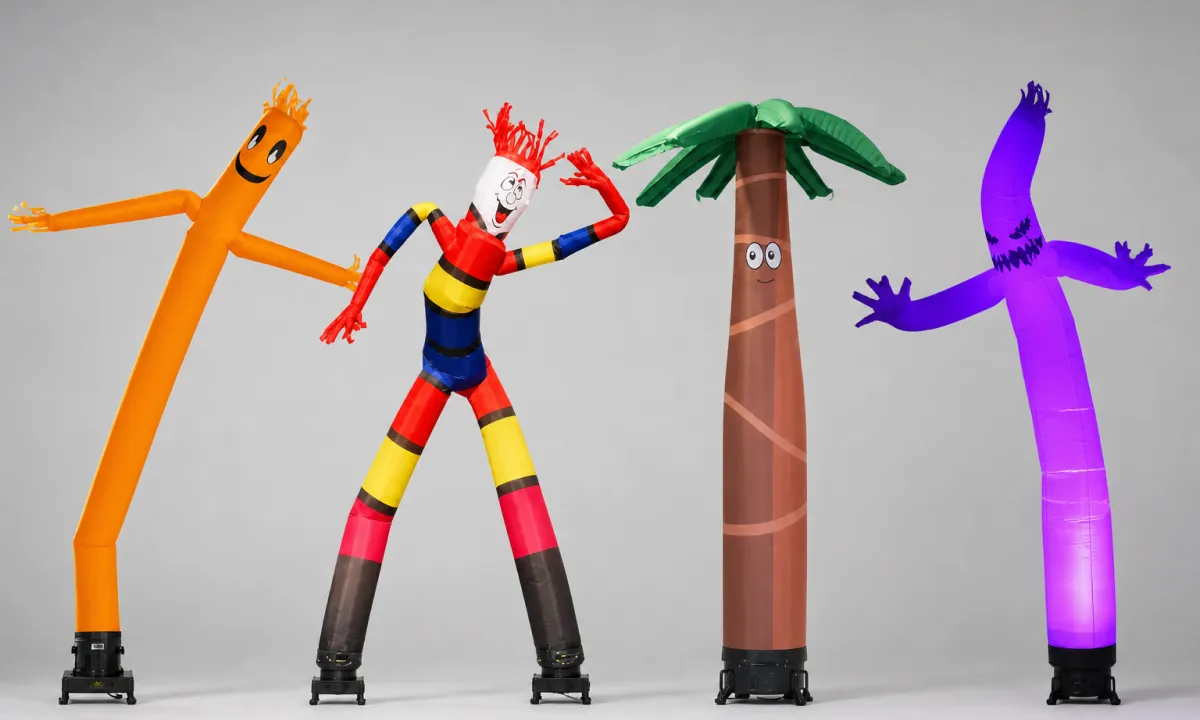
The single-leg classic is the format most buyers picture: one tube, two arms, the largest uninterrupted print area per dollar. The double-leg version reads as a standing human figure and holds its silhouette across wide parking lots. Custom-shape builds translate a mascot or IP character into a dancing structure while keeping the outline and color palette intact. LED-integrated models add internal light strips in single color, RGB, or programmable modes, giving the dancer a backlit glow that carries the campaign into the evening.
How to Choose the Right Inflatable Tube Man Height
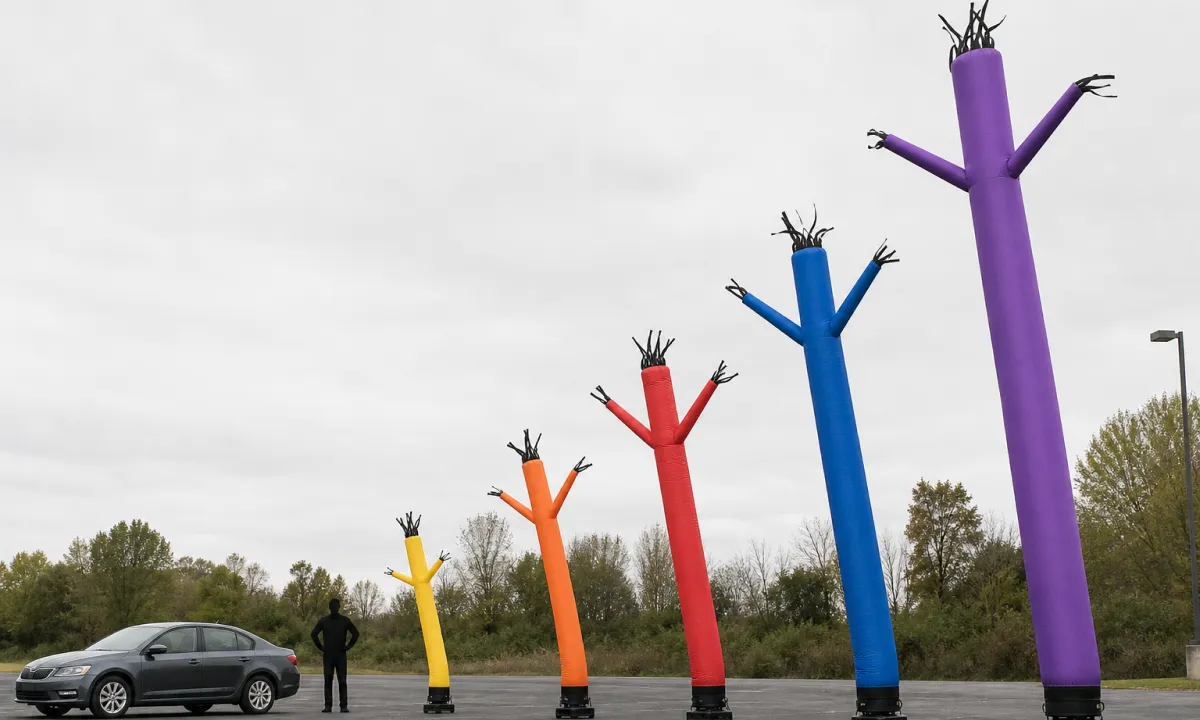
Height decides viewing distance, blower class, and power draw. Standard heights exist because they match commodity blower output classes. Stay inside them and replacement blowers stay cheap and compatible:
| Height | Tube Diameter | Blower Rating | Power Draw | Best For |
|---|---|---|---|---|
| 6 ft (2 m) | 9 in | 1/4 HP | ~150 W | Indoor displays, low-ceiling venues |
| 10 ft (3 m) | 12 in | 1/2 HP | ~250 W | Standard retail, dealerships |
| 15 ft (4.5 m) | 18 in | 3/4 HP | ~400 W | Street-level visibility, festivals |
| 20 ft (6 m) | 18 in | 1 HP | ~550 W | Long-distance visibility, large lots |
| 20 m+ giant | Custom | Industrial | 1500 W+ | Landmark campaigns, city events |
Run two checks before committing to a size. First, clearance: you need open airspace equal to the dancer height plus one meter, free of wires, branches, and awnings. Second, sightlines: a 10 ft unit works inside a parking lot, but roadside visibility past parked SUVs usually starts at 15 ft. Giant builds above 8 m need upsized blowers and engineered anchoring, and above 15 m they become landmark installations that require site-specific wind engineering.
Why the Blower Matters More Than the Fabric Body
Ask a rental operator what fails first, and the answer is never the fabric. It is the blower. Residential-grade blowers bundled with cheap online listings typically run 200 to 400 hours before the motor gives out, roughly one season of weekend use. Commercial-grade blowers are rated for 24/7 continuous operation and last 3,000 to 5,000 hours, about one to two years of daily 8-to-12-hour deployment.
Match three specs when you buy. Diameter: the fabric sleeve must fit the blower outlet, with 18 inches as the common class for 15 to 20 ft dancers. Power: an undersized blower leaves the figure sagging at half height. Voltage: 110 V or 220–240 V with the correct plug standard for your market, and CE or UL certification on the unit. Noise runs 75 to 89 dB, about the level of street traffic, which blends in outdoors but needs planning indoors.
The blower is also your main operating cost. A 10 ft dancer drawing about 250 W and running 12 hours a day uses roughly 90 kWh per month. A 15 ft unit at 400 W uses about 144 kWh; a 20 ft unit at 550 W, about 198 kWh. A ten-dealership rollout of 10 ft dancers means around 900 kWh per month. Put electricity in the budget before the first power bill arrives.
Fabric and Printing: What Determines How Long It Lasts
Tube man fabric has to be light enough to dance and strong enough to survive it. Ripstop nylon, the material used for parachutes, is the professional default: high tear strength at very low weight. Coated 210T polyester is the budget alternative, and heavier Oxford weaves appear in builds meant for long outdoor deployments. Our Oxford cloth vs PVC comparison covers how these fabrics behave outdoors in detail.
Construction quality shows at the stress points. Look for double-stitched seams with bar-tack reinforcement at the base and arm joints, where cheap builds tear first. For printing, insist on dye-sublimation: the ink bonds inside the fibers, so the graphic survives folding, UV exposure, and rain. Surface-printed graphics crack and fade within a season, and UV-treated finishes extend fabric life further.
Custom Printing and Branding Options
A stock red dancer tells drivers that something is happening here. A custom-printed one tells them your name. Full-body dye-sublimation carries logos, brand colors locked to Pantone references, faces, clothing details, and campaign messages across the entire figure. Brand mascots and IP characters can be rebuilt as dancing tube structures while the silhouette and palette stay recognizable.
Design for a moving medium: one large logo, three to five words maximum, high contrast against the sky. Drivers see the figure for seconds, at an angle, in motion. Any detail that depends on the fabric holding still will never be read. A structured inflatable design process with 3D render approval before production removes the guesswork from what the finished dancer will look like.
Stock vs Custom Inflatable Tube Man: A Cost Reality Check
| Stock (Off-the-Shelf) | Custom (Factory-Built) | |
|---|---|---|
| Lead time | Ships immediately to 7 days | 7–15 days standard; 15–20 days large or complex; 20–30 days giant or full IP builds |
| Price | Lowest entry cost | Typically 2–4 times a retail unit |
| Branding | Pre-printed generic graphics | Full-body Pantone-matched print |
| Lifespan | Residential components, 200–400 blower hours | Commercial components, 3,000–5,000 blower hours |
| Best for | One-off weekend sale | Ongoing campaigns, multi-location rollouts, brand activations |
For a single weekend promotion, stock is the rational choice. For anything beyond that, the math favors custom: reinforced fabric, a commercial blower, and branded print pay back across months of daily use. Rush production compresses custom lead times at a 20 to 30 percent premium. Multi-unit buyers should ask about batch pricing above ten pieces, Pantone consistency across batches, and keeping spare blowers and patch kits in a central inventory.
Setup, Placement, and Local Rules
Placement decides performance more than design does. Position the dancer within 15 to 30 meters of the road, perpendicular to traffic flow, on level concrete, asphalt, or compacted soil. Keep the power source within five meters, because long extension cords reduce blower output. Anchor the base with stakes on soft ground or sandbags on hard surfaces.
Wind is the hard limit. Below moderate wind, airflow only enhances the dance. Above 38 km/h, Beaufort Force 5, deflate immediately: at that point the structure can detach and become a hazard. Anchoring exists for normal operation, not storm survival. Many municipalities also regulate temporary inflatable signage near roads, so check local rules before a long-term installation. Indoors, confirm ceiling clearance and plan for blower noise before booking the venue.
Buyer's Checklist: Ten Questions Before You Order
- Is the blower included, or sold separately?
- What is the blower rated lifespan in hours, and is it commercial-grade?
- Do the fabric sleeve diameter and the blower outlet match?
- Are the voltage and plug standard correct for my market, with CE or UL certification?
- What fabric is used, and is the stitching reinforced at the base and arm joints?
- Is the print dye-sublimation, and can colors be Pantone-matched?
- What is the real lead time for my design and quantity?
- What is the warranty period? Twelve months is the commercial benchmark.
- Are repair kits, spare blowers, and replacement sleeves available?
- What does shipping cost to my destination, and who handles customs?
The right inflatable tube man earns its keep every day it dances; the wrong one is an expensive lesson in specifications. Whether you are planning a single storefront unit or a multi-market rollout, we build dancers from 2 m to 20 m and beyond, with a free 3D render before you commit. Send us your target height, quantity, and brand assets, and we will return a render and a full quote within a few business days. Start your custom inflatable tube man project here.
FAQ
The most common industry term is inflatable tube man, especially in the United States. The same product is also sold as an air dancer, sky dancer, or wacky waving inflatable arm-flailing tube man. All of these names describe one product: a fabric figure animated by a continuous blower.