Sports Dome Cost: Permanent Air Domes vs Temporary Inflatable Structures
Ask three suppliers what a sports dome costs and you will get three answers that are not comparable, because the word "dome" covers two different product categories. A permanent air-supported dome is a pressurized, code-compliant building that runs industrial blowers around the clock. A temporary inflatable structure is an event-grade product engineered for deployments of days to months. Their costs differ by an order of magnitude, and so do the projects they suit. This guide lays out current cost figures for both categories, the operating and hidden costs behind the headline price, and a practical way to decide which one your project actually needs.
How Much Does a Sports Dome Cost?
Short answer: a permanent air-supported sports dome costs about $25–50 per square foot for the dome package, and total project budgets run from roughly $1 million for a single small court to more than $4.5 million for a full-size football facility. European figures land in the same range: a UK tensile contractor quotes a two-court tennis air dome at £150,000–200,000, before VAT, groundworks and professional fees.
| Scope | Total project cost | Source |
|---|---|---|
| Small court / pickleball air dome | $1.0M–2.6M | US sports venue cost data, 2025–26 |
| Multi-sport or football air dome | $2.2M–4.6M | US sports venue cost data, 2025–26 |
| Two-court tennis air dome (UK) | £150,000–200,000 + VAT and site costs | Collinson Tensile |
| Vendor entry-tier "small dome" | From $30,000 | Broadwell (membrane package only) |
Two cautions on headline numbers. Advertised entry prices such as "from $30,000" usually cover only the membrane package — not blowers, HVAC, doors, foundations or installation. And most published totals are US or UK supply-and-install figures, which include Western labor and engineering rates. What the structure itself costs from a manufacturer is a different question, and we come back to it below.
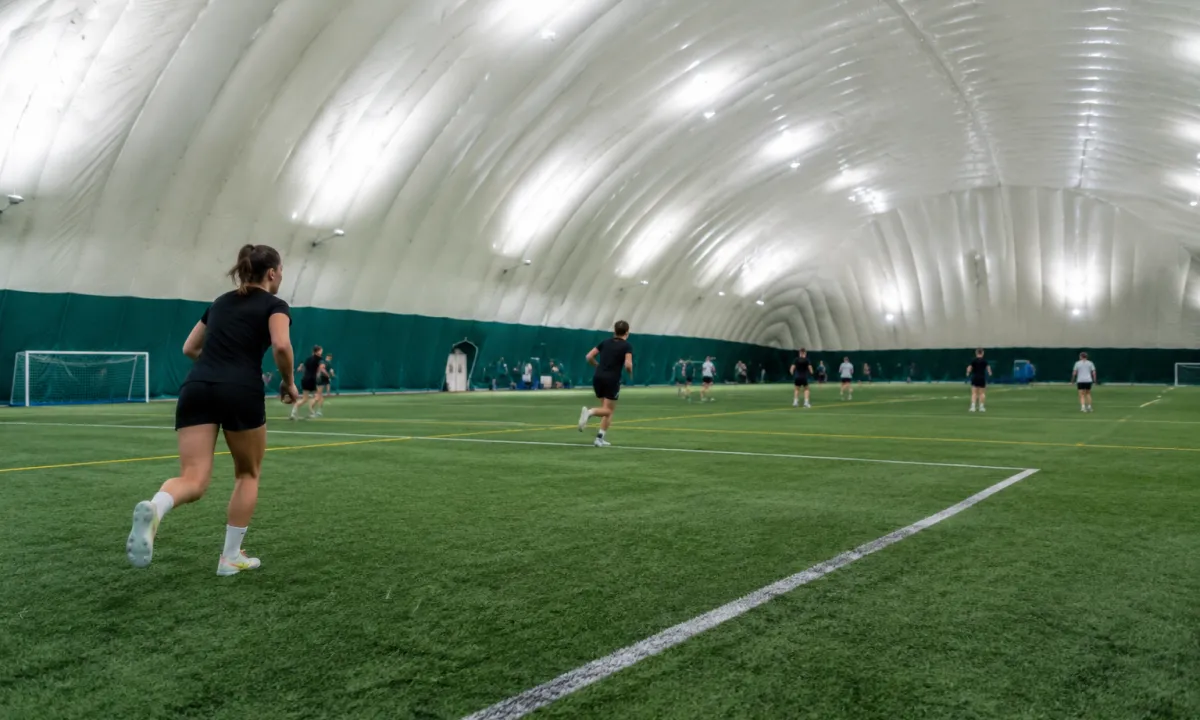
What Makes Up the Cost of an Air Dome?
A permanent dome budget has far more in it than fabric. A complete project includes:
- Membrane structure, often with an insulation liner
- Primary and standby blower systems
- Anchoring and foundation ring beam
- Airlock entrances, emergency exits and vehicle doors
- Sports lighting and electrical systems
- Heating, ventilation and air conditioning
- Site preparation and utility connections
- Design, structural engineering and permits
- Installation crew — up to 50 people for days to weeks on large domes
The items buyers most often under-budget are the compliance and engineering costs. A permanent dome project typically involves an architect for local code review and permit drawings, structural, mechanical and electrical engineers, a general contractor and utility contractors. One US supplier lists twelve distinct project roles before installation even begins. None of these appear in the membrane price, and together they can add a six-figure sum to a permanent installation.
The membrane itself drives a smaller but real cost difference. Architectural PVC and PE membranes in the 12–15 oz range are engineered for 15–20 years under continuous pressure; lighter coated fabrics used in event-grade structures trade that duty cycle for lower weight, smaller pack size and lower cost. For how the two most common commercial fabrics compare, see our Oxford cloth vs PVC breakdown.
What Does It Cost to Run an Air Dome Year-Round?
Budget $3–6 per square foot per year for operations. On a 95,000-square-foot dome that is $285,000–570,000 annually. One published seasonal example puts four months of operation for a three-court tennis bubble at $60,000–80,000. The published figure is a single total; in practice it breaks down roughly as follows:
| Operating item | What it covers |
|---|---|
| Electricity | Blowers running 24/7, plus HVAC — the largest single item |
| Blower maintenance | Service and replacement; blower systems wear out in 5–10 years |
| Snow and storm management | Monitoring, snow removal and emergency deflation procedures |
| Insurance | Property and liability cover for a public-occupancy structure |
| Inspection and repairs | Annual membrane inspection, patching, seam and cable checks |
Two operational realities sit behind these numbers. An air-supported dome only stands while its blowers run, so emergency power and storm protocols are part of the operating budget, not optional extras. And a seasonal dome is not free when it is down: spring installation and autumn removal each require a professional crew, and the field sits unused during both windows.
How Long Does an Air Dome Last?
Membranes are typically rated for 10–20 years depending on material and climate; blower systems need major service or replacement every 5–10 years. End-of-life costs are real and rarely discussed. Published removal and replacement figures run from $10,000–30,000 for domes under 100 feet in diameter, $30,000–100,000 for mid-size domes, and past $1 million for the largest facilities. A secondary market for used domes exists, but inventory is thin, and a used membrane still needs fresh engineering, anchoring and blower work for its new site.
Air Dome vs Traditional Construction
| Air-supported dome | Traditional construction | |
|---|---|---|
| Construction cost | Claimed 50–75% less | Baseline |
| Build time | Weeks to a few months | One to two years |
| Lifespan | 10–20 years (membrane) | 30–50+ years |
| Approvals | Building permits still required | Full permitting |
| Best for | Seasonal sports coverage on a budget | Year-round institutional facilities |
One caveat: the 50–75% saving figure comes from air dome suppliers themselves. Independent project totals still show seven-figure budgets, so treat the percentage as a vendor claim and compare absolute numbers instead.
Do You Actually Need a Permanent Air Dome?
This is the question most cost guides never ask, and it changes the budget by an order of magnitude. A permanent air-supported building is engineered for year-round public occupancy: continuous 24/7 pressurization, industrial blowers with emergency power backup, and compliance with building codes for permanent structures. Much of the demand behind "sports dome cost" searches is shorter than that — a season of training coverage, a tournament, a touring event, a brand activation at a sports venue. For those needs, event-grade inflatable structures are a separate product category with different engineering standards and very different pricing.
A practical way to decide:
- Year-round public use (12+ months): a permanent air-supported dome or a traditional building. This is a construction project; budget and plan accordingly.
- One season per year, recurring: compare a seasonal air dome against a temporary structure on cost per season, including annual installation and removal labor.
- Days to weeks per deployment: tournaments, fan zones, touring events and brand activations are the natural territory of temporary inflatable structures.
- Approval-constrained sites: temporary structures generally follow a simpler approval path than permanent buildings, which is often decisive for school and municipal sites.
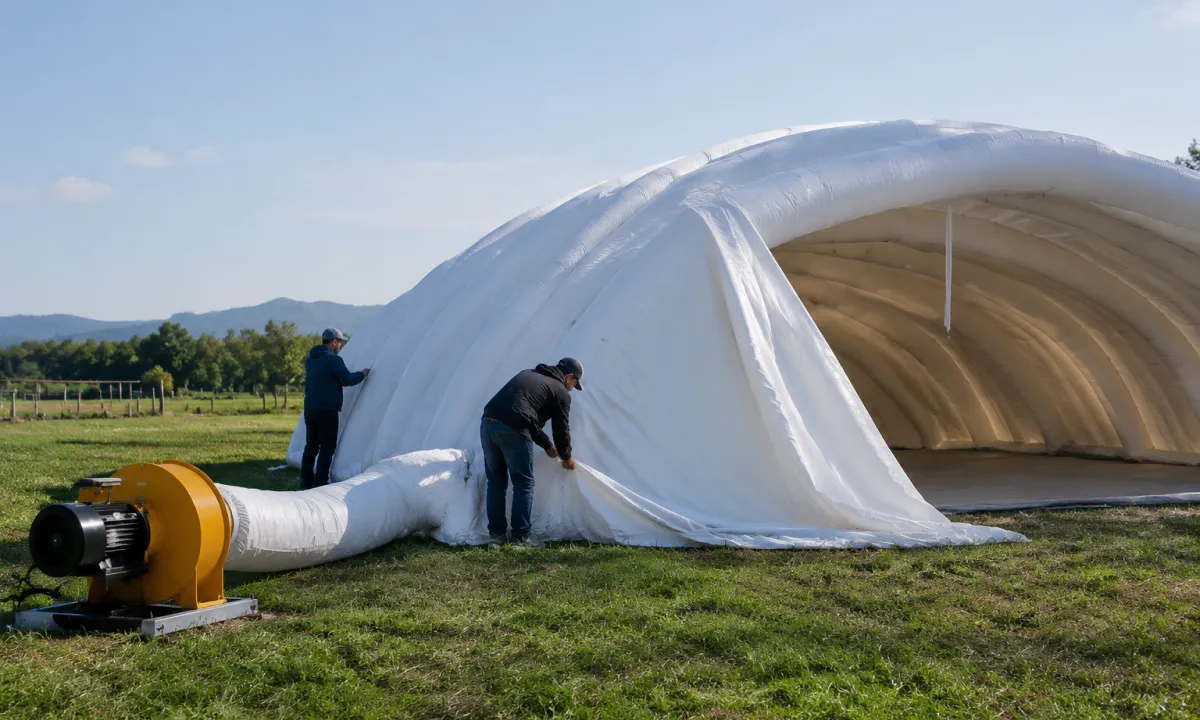
What Does a Temporary Inflatable Structure Cost?
Event-grade inflatable architecture is custom-manufactured and quoted per project rather than sold off a price list. As a reference frame, custom commercial inflatables typically run from about $500 to $20,000+, with most brand and event pieces falling in the $2,000–$8,000 band and large multi-component architectural projects quoted individually. Even at the top of that range, an entire temporary structure costs less than one year of operating a permanent dome.
The engineering profile is built for repeated deployment rather than permanent occupancy. Using our own production specifications as an example: spans from 5 m to 30 m and beyond, with multi-component structures for larger footprints; setup in 30 minutes to 4 hours instead of days or weeks; redundant blowers on large spans; wind resistance up to 38 km/h fully anchored; CE and UL certified; a 12-month warranty; and a service life of 5–10+ years across 50–100+ deployment cycles. Production lead time is 20–45 days depending on complexity, and complex projects receive a 3D render, structural engineering preview and full quotation within one to two weeks.
| Permanent air dome | Temporary inflatable structure | |
|---|---|---|
| Cost magnitude | $1M+ project | Thousands to low five figures |
| Deployment duration | Year-round, permanent | Days to months |
| Setup | Days to weeks, large crew | 30 minutes to 4 hours |
| Operating requirement | 24/7 industrial blowers + backup power | Commercial blowers during use |
| Engineering standard | Building code, permanent occupancy | Event-grade, temporary deployment |
| Best for | Year-round sports facilities | Seasonal coverage, events, touring |
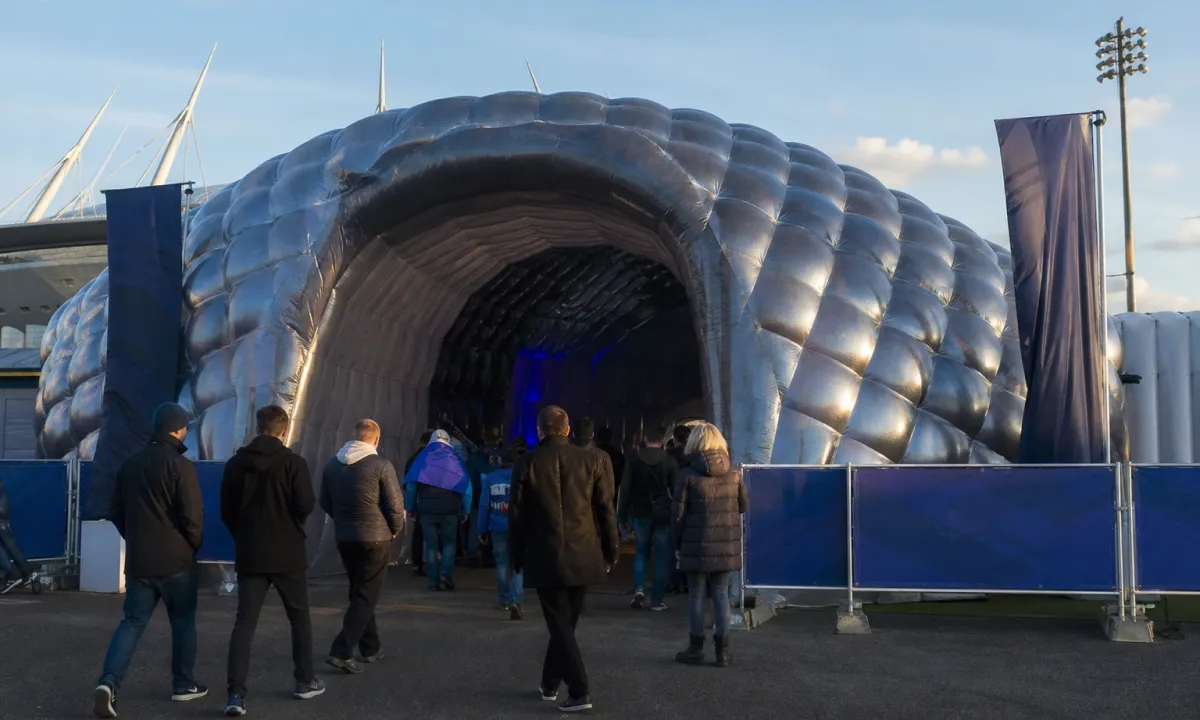
For sports applications, the temporary category covers seasonal training covers, tournament venues, fan zones and activation spaces — see our inflatables for sports events solutions for typical configurations. We design and manufacture this category at 360 Inflatable as custom inflatable architecture: domes, corridors, pavilions and immersive spaces built to your footprint and branding.
How to Budget Your Sports Coverage Project
Whichever category fits, the budgeting sequence is the same:
- Fix the deployment duration first. It decides the product category, and getting it wrong is the most expensive mistake in this market.
- Measure the site. Footprint, height clearance, wind exposure, ground type and power access all feed directly into engineering and price.
- Request itemized quotes. Membrane, blowers, HVAC, site works, permits and installation should be separate lines; refuse lump-sum figures.
- Add the operating budget. For permanent domes, $3–6 per square foot per year; for temporary structures, blower power during use and storage between deployments.
- Compare cost per season of use. The right metric is what one covered season costs you, not the headline price.
If your project belongs to the event-grade category, the fastest way to a real number is a project brief. Send us the intended use, target dimensions, deployment site and timeline, and we will return a 3D render, structural preview and itemized quotation within one to two weeks. For broader context on inflatable pricing, our custom giant inflatables cost guide covers the general cost structure of commercial inflatables.
FAQ
A permanent air-supported sports dome costs about $25–50 per square foot for the dome package, with total projects ranging from roughly $1 million for a small single court to over $4.5 million for a full football facility. Temporary event-grade inflatable structures cost far less — from thousands to low five figures — but serve deployments of days to months rather than permanent use.
Published US figures put the dome package at $25–50 per square foot, excluding site work, HVAC, permits and installation. Total installed cost per square foot is significantly higher once those items are included. Entry prices advertised below this range usually cover only the membrane.
Budget $3–6 per square foot per year. A 95,000-square-foot dome costs roughly $285,000–570,000 annually to operate, covering 24/7 blower electricity, HVAC, blower maintenance, snow and storm management, insurance, and annual inspection and repairs.
Membranes are typically rated for 10–20 years depending on material and climate, while blower systems need major service or replacement every 5–10 years. Removal and replacement costs range from $10,000–30,000 for small domes to over $1 million for the largest facilities.
Decide by deployment duration. Year-round public use (12+ months) calls for a permanent air-supported dome or traditional building. Seasonal or event-based use — training coverage, tournaments, touring events, brand activations — is usually served better and far cheaper by event-grade temporary inflatable structures.
Event-grade inflatable architecture is quoted per project. As a reference, custom commercial inflatables typically run $500–$20,000+, with most brand and event pieces in the $2,000–$8,000 band and large multi-component structures quoted individually. Even the top of that range is below one year of operating a permanent dome.
Yes. Permanent dome projects are commonly financed through grants, community fundraising, loans and tax depreciation incentives, because they qualify as construction projects. Temporary inflatable structures are usually purchased outright given their far lower cost.
Permanent air-supported domes generally require building permits and code review like other construction. Temporary inflatable structures for short-term deployment usually follow a simpler approval path, though requirements vary by jurisdiction — confirm with your local authority before installation.