NFPA 701 Certification for Inflatables: Test Methods & Buyer Checks
Quick answer: NFPA 701 is the US fire test standard for textiles and films used in public spaces. It checks whether a fabric keeps a flame spreading after a small ignition source touches it. When a lab tests a fabric to this standard and the fabric passes, it is what people call "NFPA 701 certified." US venues usually ask for this proof before a large inflatable is installed indoors, so when you buy a custom inflatable, you need to be clear on three things:
- What proof to provide: a laboratory test report on the exact fabric the inflatable is made from. If the fabric changes, you need a new report that matches it.
- Which test method applies: NFPA 701 has two tests, Method 1 and Method 2, divided by fabric weight and construction. The coated fabrics common in inflatables are heavier, so most are tested under Method 2.
- Which certificates cannot replace it: a Chinese B1 fire report and a CPAI-84 tent certificate each use their own specimen setup and pass limits, so a fabric that passes one of them has not shown it can pass NFPA 701. US venue fire requirements usually name NFPA 701 directly, and reviewers accept only a report to that standard.
Below, we first explain how NFPA 701 is actually tested and why most inflatable fabrics go through Method 2. Then we use one of our own SGS reports to show how to read and verify a passing report, and finally how a custom order gets the fire documents a venue will accept.
What Is NFPA 701 Certification?
NFPA 701 is a fire test standard published by the National Fire Protection Association (NFPA). NFPA writes the fire and life-safety codes that many US states and cities adopt as law, and those codes refer to NFPA 701 for curtains, drapes, tents, and other fabric used in public spaces. A large inflatable belongs to the same group, because it is a large area of fabric inside a public building.
In the test, a laboratory hangs fabric specimens vertically and holds a flame to their lower edge for a set time. After removing the flame, the lab records three things: how far the fabric charred, how long it kept burning by itself, and whether burning pieces dropped off. These results show whether the fabric helps a small flame spread, which is why a fabric that passes is described as flame retardant. How long a wall or barrier can hold back a fully developed fire is a different property, called fire resistance, and other standards test it.
In practice, "NFPA 701 certified" means the supplier holds a laboratory report showing that the fabric passed. That report covers only the sample the lab received; our SGS report states that its "results apply to the sample as received." A pass for one fabric therefore says nothing about another fabric, color, or coating, even from the same supplier. Most commercial inflatables are made from coated Oxford cloth or PVC tarpaulin (see our inflatable materials and quality guide), and each of these materials needs its own report.
Why Do Custom Inflatables Need to Meet NFPA 701 Requirements?
Custom inflatables need it because US fire codes treat a large inflatable as fabric in a public space. These codes require fabric used in public buildings, such as decorations, drapes, and tents, to pass a flame propagation test, and NFPA 701 is the test they most often name. Before an installation, the venue's fire reviewer, often the local fire marshal, asks for the test report on the inflatable's fabric. Without it, the venue may not allow the piece to be installed.
The projects that most often go through this check are:
- Brand displays and seasonal installations in shopping malls
- Exhibition hall and trade show pieces
- Concert and touring stage inflatables that move from venue to venue
- Inflatable tents, domes, and other inflatable architecture used as event spaces
The exact rule depends on the fire code each city or state has adopted. California's 2025 Fire Code, in force since January 1, 2026, shows what these rules look like when they name inflatables directly:
- Inflatable amusement devices (Section 3106): they must be designed, anchored, operated, and maintained under the manufacturer's instructions and ASTM F2374. Their materials must meet the flame propagation criteria of California Title 19, Chapter 8, and each device must carry a permanent label and affidavit.
- Tents and membrane structures (Section 3104): their materials must be tested by a laboratory approved by the California State Fire Marshal. The permanent label must state the fabric, the manufacturer's name and address, and compliance with the flame propagation requirement. For treated fabrics, it also lists the treatment date, the chemical used, who applied it, and the testing agency and test standard.
In these sections California uses its own flame test, Title 19, so a project in California may need a Title 19 registration in addition to an NFPA 701 report. For any venue, the practical step is the same: get its fire requirements in writing before production starts, because they decide the fabric, the test, and the label.
NFPA 701 Fabric Testing: Method 1 vs Method 2
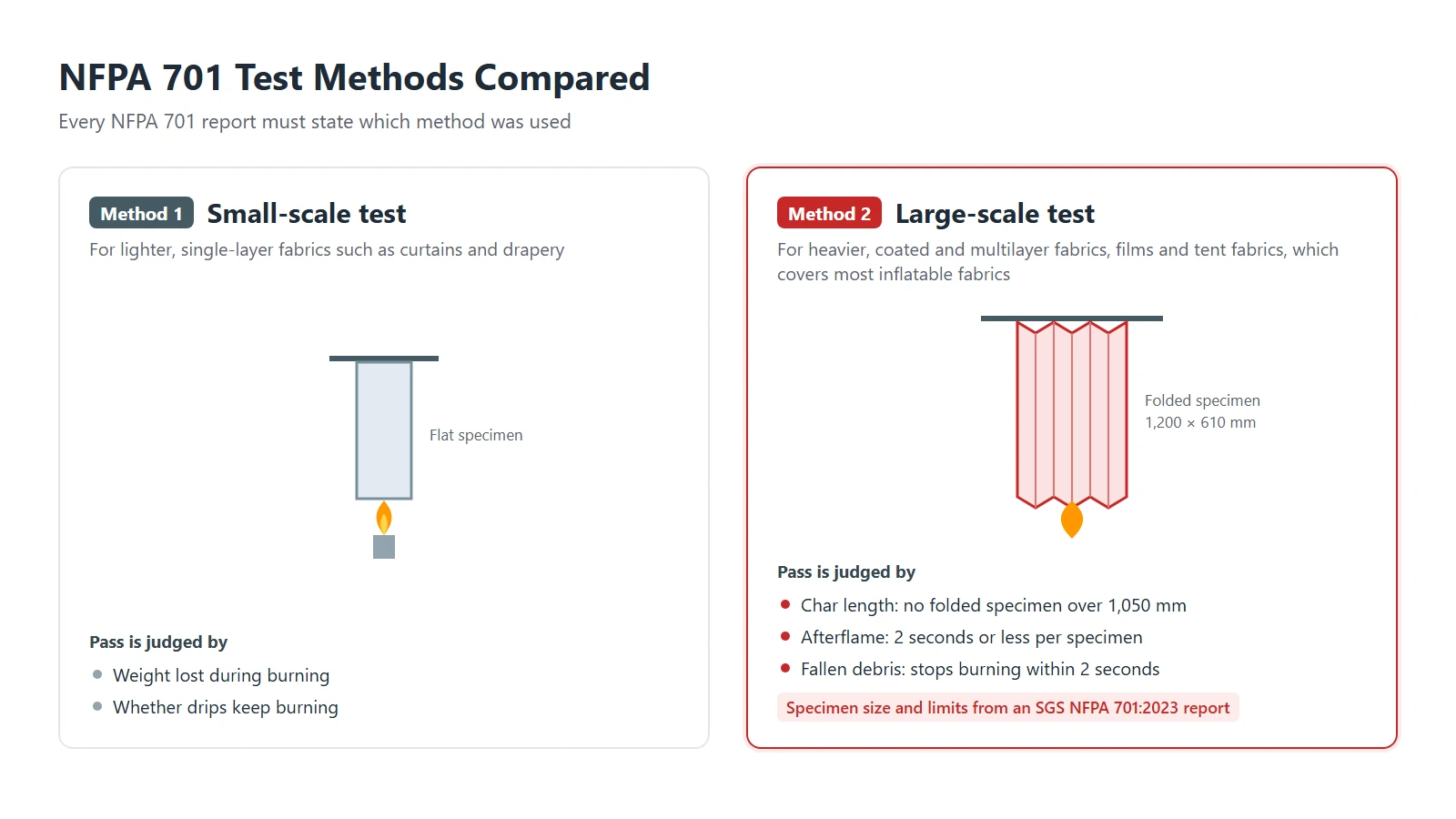
The test method is the first thing to check on a report. NFPA 701 has two methods for different kinds of material, and each method has its own pass criteria.
| Test method | Used for | How a pass is judged |
|---|---|---|
| Method 1 | Lighter, single-layer fabrics such as curtains and drapery | Weight lost during burning, and whether drips keep burning |
| Method 2 | Heavier, coated, and multilayer fabrics, films, and tent or awning fabrics | Char length, afterflame time, and whether fallen debris keeps burning |
Method 2 uses larger specimens and usually folds them, so the fabric hangs in pleats the way gathered fabric does in use. Each folded specimen in our SGS test measured 1,200 mm by 610 mm.
Most inflatable fabrics fall under Method 2 because they are coated or multilayer. Oxford cloth for inflatables carries a coating, PVC tarpaulin is a coated fabric, and printed panels, appliqués, and seams add extra layers. Our Oxford cloth vs PVC comparison explains how the two main materials differ in weight, printing, and outdoor use.
What Does a Passing NFPA 701 Test Report Look Like?
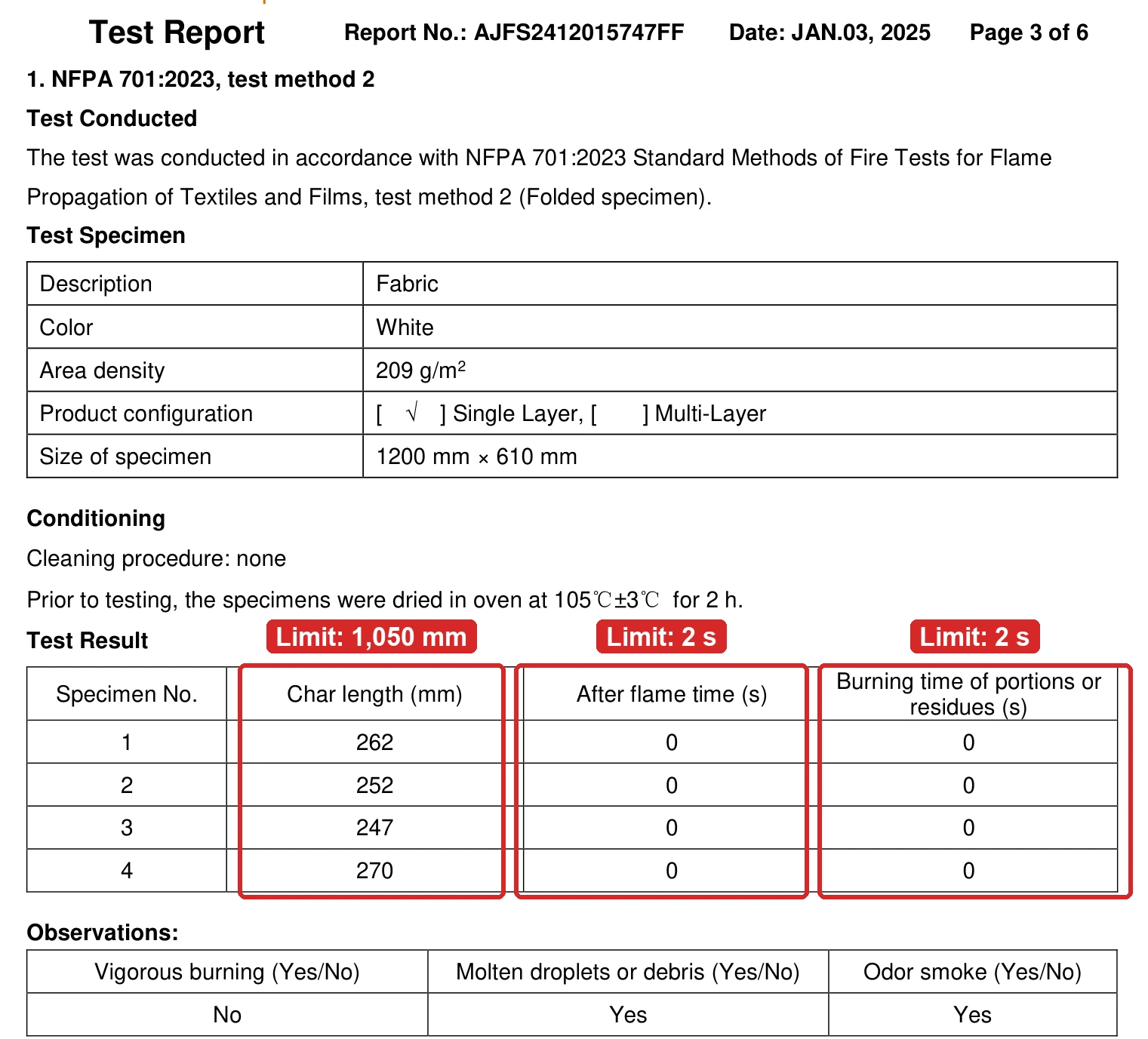
Once you know the method, a report is straightforward to read. The example below is the SGS report on a 300D polyester fabric that 360 Inflatable submitted for testing (report No. AJFS2412015747FF, issued January 3, 2025). Its first fields identify what was tested and how:
| Report field | What to check | In this report |
|---|---|---|
| Standard and edition | The standard and its year | NFPA 701:2023 |
| Test method | Method 1 or 2; flat or folded specimens | Method 2, folded specimens |
| Sample description | Must match the fabric in your quotation | 300D polyester, white, 209 g/m², single layer |
| Conditioning | Any cleaning or weathering before the test | No cleaning; oven-dried at 105 ± 3 °C for 2 hours |
| Conclusion | Pass or fail, signed by the lab | Pass |
Char Length, Afterflame and Drips: the Three Results That Decide a Pass
The result section then records three measurements for each folded specimen and compares them with the limits in Chapter 15 of the standard. The fabric fails if any one of these limits is exceeded:
- Afterflame: a specimen keeps flaming for more than 2 seconds after the test flame is removed.
- Char length: the char on a folded specimen is longer than 1,050 mm.
- Burning debris: pieces that fall to the floor keep burning for more than 2 seconds.
Our four specimens charred 247, 252, 262, and 270 mm, so even the longest char used about a quarter of the 1,050 mm limit. Afterflame time was 0 seconds on all four, and fallen residue burned for 0 seconds. The lab did record molten droplets, which polyester normally produces; they did not count against the fabric because none kept burning on the floor.
The standard also allows one retest: if one of the four specimens fails, two new specimens cut in the same direction are tested, and both must pass.
NFPA 701 vs CPAI-84 vs China B1: Are They Interchangeable?
Suppliers in China usually hold a fire report under the Chinese B1 rating, and tent suppliers often list CPAI-84. Each is a separate test with its own flame, specimens, and limits, so neither can stand in for NFPA 701. The table compares NFPA 701 Method 2 with China B1 item by item:
| Item | NFPA 701, Method 2 (folded) | China B1 (GB/T 17591, decorative fabric) |
|---|---|---|
| Test setup | Large folded specimens hung vertically | GB/T 5455 vertical method, 12-second butane flame |
| Afterflame limit | 2 seconds, each specimen | 5 seconds |
| Damage limit | Char length up to 1,050 mm | Damaged length up to 150 mm |
| Burning drips | Debris on the floor must stop burning within 2 seconds | Recorded, including whether cotton placed below ignites |
Because the flame, the specimen size, and the length measured all differ, a B1 result cannot be converted into an NFPA 701 result. Our 600D Oxford cloth shows this: it passed B1 with an average damaged length of 120 mm in the warp direction and 96 mm in the weft direction, and those figures still say nothing about how it would perform under NFPA 701. Only an NFPA 701 test on the same fabric answers that. The standard name printed on a report tells you which test it is: GB/T 17591 or GB/T 5455 means the Chinese test.
CPAI-84 is a flammability specification written for tent materials. A CPAI-84 certificate shows the CPAI-84 result only, so if your venue asks for NFPA 701, ask the supplier for an NFPA 701 report.
How to Verify an Inflatable Supplier's Fire Certificate
The points above turn into a checklist for any fire document a supplier sends. Go through it before approving production:
- Ask for the full test report. A certificate page or a logo on a brochure leaves out the method, the sample, and the results.
- Check the standard and edition. The report should read NFPA 701 with a year, such as NFPA 701:2023, and state Method 1 or Method 2.
- Match the sample to your order. Compare the fabric type, denier or thickness, weight per square meter, color, and coating with the fabric in your quotation.
- Verify the laboratory and the report. Note the lab name, report number, and issue date. Many labs print a QR code or a verification website on the report; our SGS report points to check.sgsonline.com.cn.
- Read the result page. Look for "Pass" together with the specimen data behind it.
- Ask about the finished piece. Printing, coatings, glued or welded seams, and multilayer sections are added after the fabric is tested. Ask the venue whether a fabric report is enough or whether it wants a test on a sample of the finished material.
- Plan labels and paperwork. If the piece is a tent or membrane structure in California, the permanent label must carry the details listed in Section 3104.3, so agree with the supplier on who makes and attaches it.
Fire documents are one part of checking a supplier. Our guide on how to choose an inflatable manufacturer covers factory checks, quality control, and lead times.
How to Get NFPA 701 Documentation for a Custom Inflatable Order
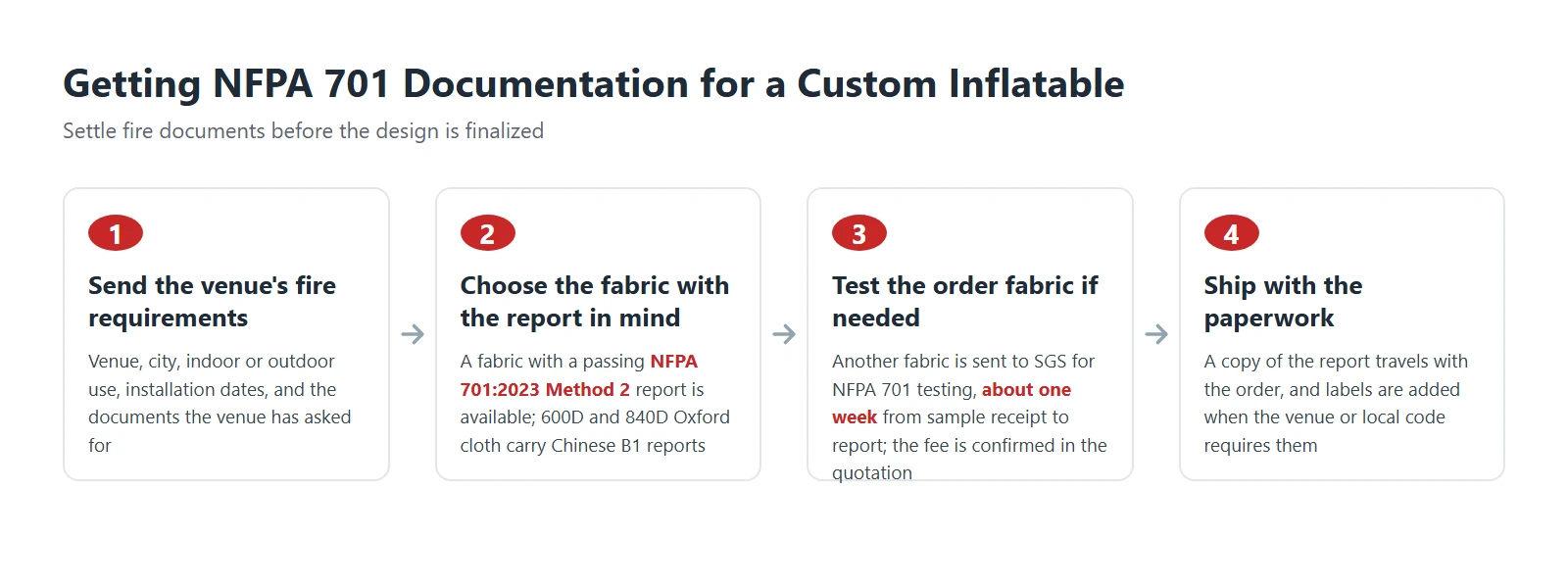
For a custom piece, the fire report is easiest to get when it is planned together with the design. The process we follow has four steps:
- Send the venue's requirements with your inquiry. Include the venue, city, indoor or outdoor use, installation dates, and the fire documents the venue has asked for.
- Choose the fabric with the report in mind. 360 Inflatable has a fabric with a passing NFPA 701:2023 Method 2 report from SGS. Our 600D and 840D Oxford cloth carry Chinese GB/T 17591 B1 reports.
- Test the order fabric when needed. If the design calls for another fabric, we send it to SGS for NFPA 701 testing. Our last test took about one week from sample receipt to report, and the test fee is confirmed in the quotation.
- Ship with the paperwork. A copy of the report travels with the order, and labels are added if the venue or local code requires them.
When you request a quote for a custom giant inflatable, include the venue's fire requirements so the fabric and the test are planned into the production schedule.
FAQ
It means a laboratory tested that specific fabric or film to NFPA 701 and it passed. Check the report for the test method, the edition of the standard, and a sample description that matches the material you are buying.