Best Inflatable Manufacturers: How to Choose the Right Partner
Type best inflatable manufacturers into Google and the results mix self-published top-ten lists, directories, and factory homepages. A fixed league table serves a B2B buyer poorly: the right manufacturer for a rental fleet of bounce houses is a different company from the right one for a 20-meter custom brand character. The useful question is which manufacturer fits your project, and that question has a systematic answer.
This guide is written from the factory side. 360 Inflatable has manufactured custom inflatables since 2006, in a 10,000-square-meter production base with a 108-person team, delivering more than 3,000 projects a year to clients in over 40 countries. Below is the evaluation framework we would apply as the buyer: how to define "best" for a B2B project, how to verify a factory, what to demand on materials, customization, quality control, and cost, and how to turn that framework into a shortlist before you request quotes.
What Makes an Inflatable Manufacturer "Best" for B2B Buyers?
For B2B buyers, the best inflatable manufacturer is the supplier whose product category, production capacity, materials, safety standards, customization process, lead time, quality control, warranty, and export experience match the project's requirements. "Best" is a measurable fit across ten dimensions, and it shifts with the project: a rental operator, a brand agency, and a water park developer will each land on a different answer.
Score any candidate on these ten dimensions:
- Category fit — builds your product type, at your scale, as core business
- Production capacity — facility size, team, equipment, annual project volume
- Materials and construction — fabric options, seam work, reinforcement methods
- Safety standards and testing — documented certifications, wind and load ratings
- Customization capability — design team, 3D modeling, printing, IP handling
- Lead time and MOQ — realistic production windows, order flexibility
- Quality control — a defined process, pre-shipment testing, documented results
- Warranty and support — written coverage, spare parts, repair and installation help
- Export and logistics experience — a delivery track record in your destination country
- Communication and risk terms — response speed, contract clarity, payment structure
A manufacturer that scores well across all ten is a strong candidate, wherever it sits on anyone's list.
Which Type of Inflatable Manufacturer Fits Your Project?
Manufacturers specialize, and the specialization shows in their equipment, materials, and case history. Comparing a rental-fleet factory against a custom advertising workshop on one checklist produces a misleading result, so match the candidate type to the project first:
| Manufacturer type | Typical products | What to prioritize | Common buyer mistake |
|---|---|---|---|
| Commercial rental manufacturers | Bounce houses, slides, obstacle courses for rental fleets | Seam durability, warranty covering rental use, spare parts supply | Comparing on unit price while ignoring repair turnaround |
| Custom advertising manufacturers | Branded arches, product replicas, mascots, air dancers | Design and printing quality, 3D proofing, color accuracy, IP protection | Approving production from a sketch instead of a 3D rendering |
| Giant event and parade manufacturers | Giant characters, helium balloons, art installations | Structural engineering, wind ratings, anchoring systems, installation support | Treating a 20-meter structure like a scaled-up party toy |
| Water park manufacturers | Floating obstacle courses, slides, aqua parks | Materials suited to constant water exposure, anchoring, safety compliance | Applying dry-land standards to a floating structure |
Consumer products such as pools, boats, and kayaks follow a retail buying logic and fall outside this guide. The sections below serve commercial and custom buyers, where the purchase is a project rather than a product off a shelf.
How Do You Verify Real Manufacturing Capability?
Any supplier can call itself a factory. Capability is proved by evidence a buyer can check, so ask each candidate for the same set: facility scale, team size, production equipment, annual output, and verifiable project cases. Whether a supplier produces this evidence on request is itself a scorecard item.
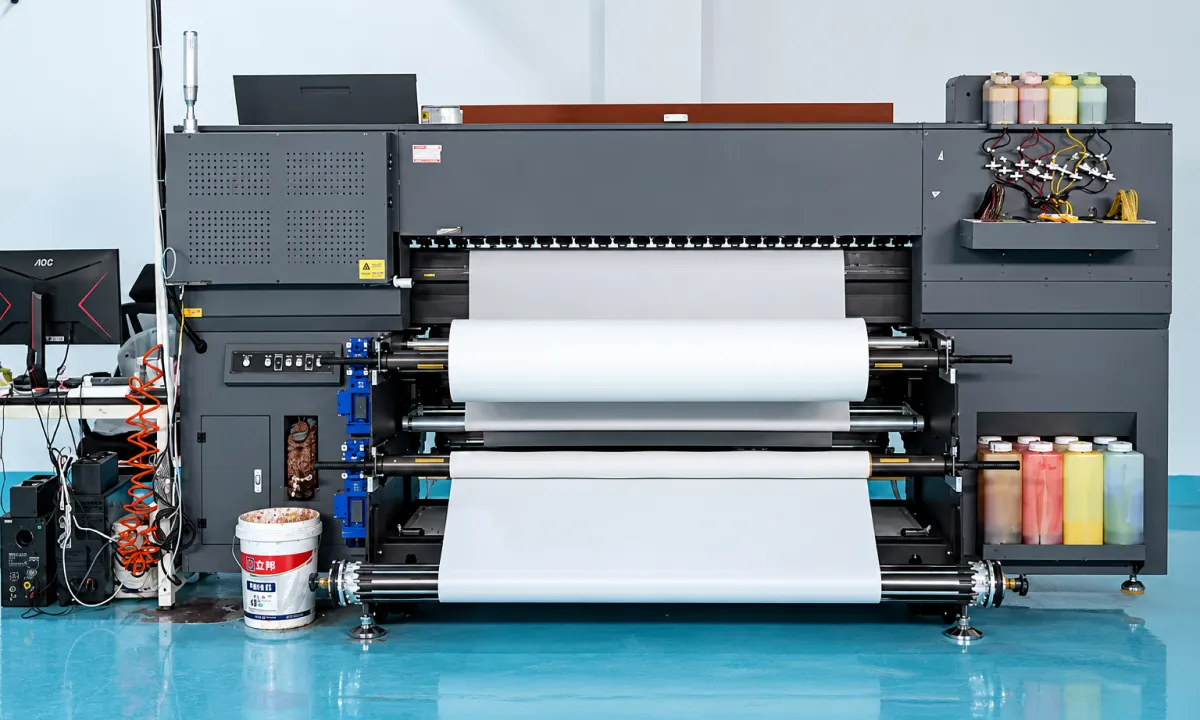
A concrete answer has numbers in it. Our own production base covers 10,000 square meters with a 108-person team. Printing runs on four imported large-format digital machines, eight-color CMYK with Pantone matching across fabric widths up to 3.2 meters. The sewing crew numbers more than 50 workers, and annual output exceeds 3,000 projects. You can see what this kind of working production floor looks like on our inflatable factory page. A candidate whose capacity answers come back as adjectives rather than figures has given you a scoring signal for free.
Design depth matters alongside physical capacity. For large custom units, ask who handles structural design and 3D modeling, and whether revisions to the model carry a charge. A factory with an internal design team answers these questions in one email.
What Materials, Safety Standards, and Engineering Details Matter?
Material should follow application. Heavy-duty commercial units lean on PVC tarpaulin; lightweight advertising shapes and helium projects use oxford and PU-coated fabrics where weight and packed size matter; water installations need materials suited to permanent water exposure. A serious manufacturer keeps a material library and recommends per project — ours covers 14 materials — and can explain why a given fabric fits your use case.
Construction details decide service life. Ask how seams are built: commercial seams should be double-stitched, with bar tacking at stress points where anchor lines and blower tubes load the fabric. These two details, more reliably than any marketing adjective, separate a five-year asset from a one-season liability.
On standards, request documents rather than claims. Commercial units should carry CE and UL documentation where applicable. For outdoor use, wind resistance engineered to BS EN 14960 is the reference point — correctly anchored, our units are rated to withstand winds up to 38 km/h. Ask for the test reports behind any stated rating.
Engineering range rounds out the picture. Our size envelope runs from 0.5 meters to over 40 meters, with integrations including LED lighting, helium suspension, water platforms, and remote control. A manufacturer quoting a complex build should show comparable completed projects.
How Should You Compare Customization, Sampling, and Lead Time?
Start with the engagement model. Under OEM, you supply the design and the factory builds it under NDA with flexible MOQ. Under ODM, the manufacturer's design team develops the concept with you, with IP terms defined up front and unlimited revision rounds. Many buyers need a mix of both; clarify which model a candidate actually runs before comparing quotes.
The proofing sequence shows how a factory protects you from surprises. Our sequence moves from brief to concept proposal, 3D rendering, and quotation within 24 to 48 hours, and production starts only after written design approval. For large or complex units, a white-model confirmation de-risks the full build before materials are committed.
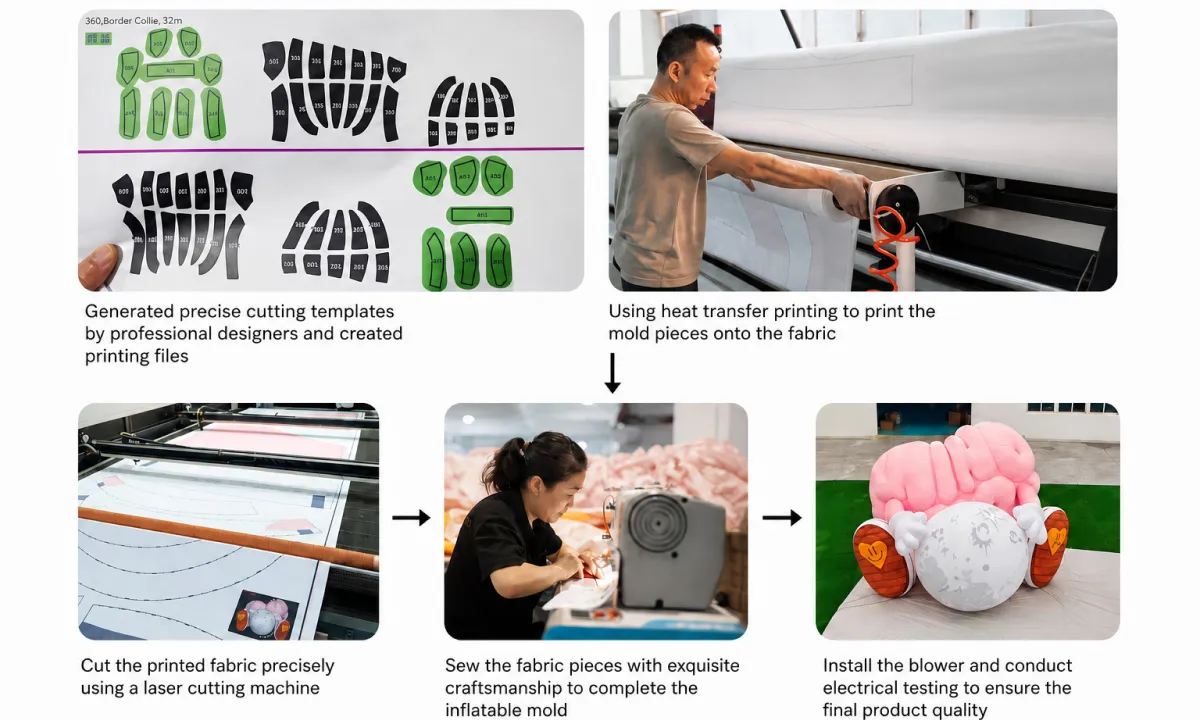
Two commercial numbers deserve direct questions. MOQ: genuine custom factories commonly accept single-piece orders — we have no MOQ — because custom work is produced to order anyway. Lead time: standard production runs 15 to 35 working days depending on scale and complexity, so work backward from the date the unit must be in your hands, with transit time added on top.
For the ordering workflow itself, from design brief through approval to delivery, our guide to the custom inflatable ordering process walks through it step by step.
What Quality Control, Warranty, and Support Should You Expect?
Quality control belongs on paper: a defined process with documented results. Our production follows a 12-step workflow from inquiry to shipment, and each unit passes a 24-hour pre-shipment inflation test covering air retention, seam integrity, and structural balance, with photos and video documented for the buyer. When you evaluate candidates, ask for the equivalent of each item on this checklist:
- A written production workflow with defined inspection points
- Pre-shipment testing on your actual unit, with photo and video evidence
- A written warranty stating duration and coverage — ours runs 12 months
- Spare parts, repair kits, and repair guidance supplied with the order
- Installation support for large units — our teams cover more than 40 countries
- A stated commercial lifespan — ours runs 5 to 10+ years depending on environment
A manufacturer that hesitates on any of these items is leaving that risk with you.
Should You Compare Factory Price or Total Landed Cost?
Quotes become comparable only on a unified basis: the same written specification, the same trade terms, the same lead time. Send each shortlisted supplier one spec sheet and require the quote against it. A low factory price built on thinner material or looser terms describes a different product.
For cross-border sourcing, the factory price is one component of the total landed cost. Freight, insurance, import duty, and local delivery all join it before the unit reaches your site, and the cost ranking of suppliers can change once they do. Compare on the landed figure.
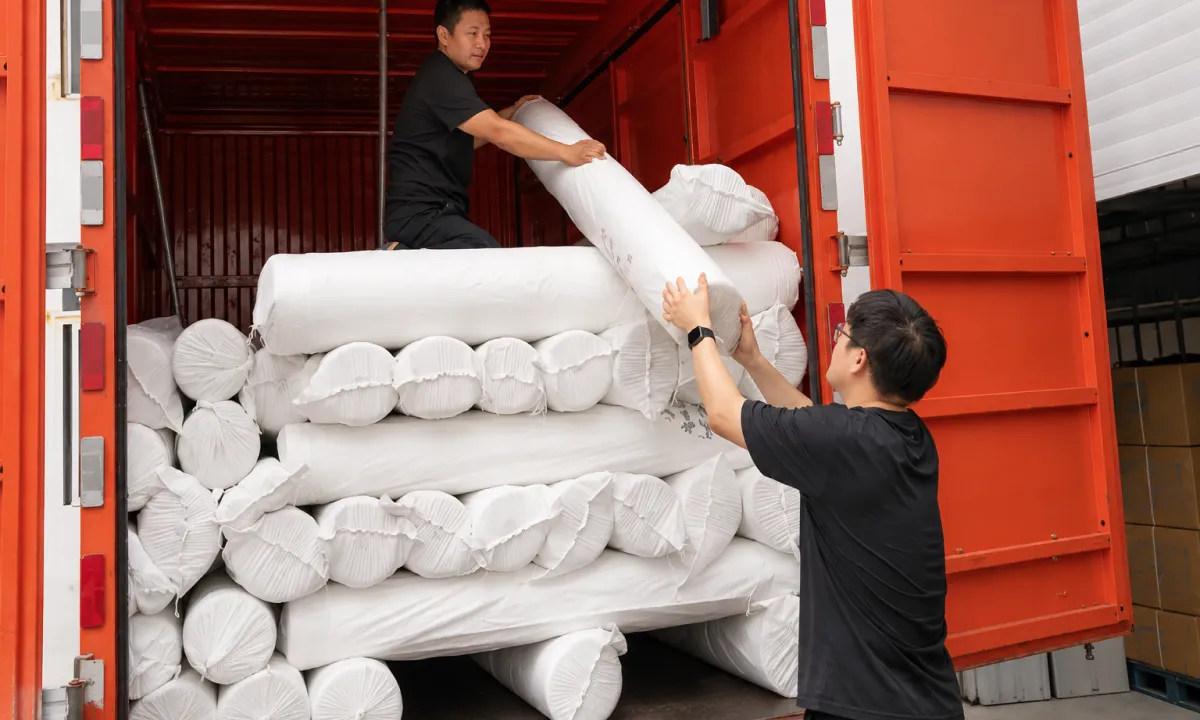
Cross-border orders also carry risk points that belong in your evaluation: payment structure, shipping arrangements, import duties, pre-shipment inspection, and IP and NDA protection. Each of these is covered step by step in our guide to importing inflatables from China, so this article keeps to the comparison principle and leaves the mechanics there.
Delivery experience in your destination country is the last check. We ship to more than 40 countries and provide on-site installation teams across the same footprint, which takes over the most failure-prone step of a large custom build.
How Can You Build a Shortlist Before Requesting Quotes?
Turn the framework into a process. Filter five to eight candidates by category fit. Score them on the ten dimensions with weights that reflect your project. Send each candidate the same RFQ template. Verify factory evidence, and request a sample or white model where the budget justifies it. Keep two backups in play until the contract is signed.
| Dimension | Suggested weight | What earns full marks |
|---|---|---|
| Category fit | 15% | Builds your product type at your scale as core business |
| Production capacity | 10% | Verified facility, team, and equipment |
| Materials and construction | 10% | Documented fabric options, double stitching, bar tacking at stress points |
| Safety standards | 10% | CE/UL documentation, wind ratings per BS EN 14960 |
| Customization | 15% | 3D proofing, defined revision policy, clear IP terms |
| Lead time and MOQ | 10% | Realistic schedule in writing, order flexibility |
| Quality control | 10% | Pre-shipment testing with documented evidence |
| Warranty and support | 10% | Written warranty, parts supply, installation help |
| Export experience | 5% | Delivery record in your destination country |
| Communication and terms | 5% | Fast, specific answers; clear contract and payment structure |
Adjust the weights to the project: a rental fleet weights durability and warranty higher, a brand activation weights customization and printing quality higher. The scorecard's value lies in forcing each candidate through the same questions — the step most published manufacturer rankings never take.
Need a Manufacturer for a Custom Inflatable Project?
If your shortlist points toward a custom build, our work covers giant advertising inflatables, IP and character replicas, arches and tunnels, art installations, and parade or helium projects, produced under the OEM and ODM models described above.
A complete inquiry takes five lines: target dimensions, the use scenario, reference images, your deadline, and the destination country. With that brief, we return a concept proposal, 3D rendering, and factory quotation within 24 to 48 hours. Start on our custom inflatables page, and put this guide's framework to the test — we are glad to be scored against it.
FAQ
No single list fits every buyer. The right manufacturer depends on your project type: commercial rental fleets, custom brand displays, giant event structures, and water parks each have their specialists. Define your category first, then score candidates on the ten dimensions in this guide — category fit, capacity, materials, standards, customization, lead time, quality control, warranty, export experience, and contract terms.