Bounce House Weight Limit Guide: How Much Weight Can a Commercial Inflatable Handle?
It is the first question parents ask at drop-off and the last thing many operators verify: how many kids can jump at once? The answer sits in one number, the bounce house weight limit, and treating that number as a suggestion is how seams split, blowers overheat, and insurance claims get denied. For rental companies and event businesses buying commercial inflatables, capacity is a purchasing spec, an operating rule, and a liability shield at the same time. This guide explains what the limit actually means, which five factors set it, the typical ratings by unit type, how manufacturers verify them, and how to choose a unit that fits your business.
What Is the Bounce House Weight Limit?
The bounce house weight limit is the maximum combined occupant weight a unit is engineered to carry safely. Manufacturers set it after testing the material, seams, structure and airflow, and publish it on the label near the entrance, on the spec sheet and in the user manual. Treat it as a hard operating limit, never a rough guideline.
Two numbers hide inside that single rating. The total limit caps all occupants together, while a per-person limit caps each jumper. A castle rated at 250 pounds with a 50-pound per-person cap is really a five-child unit. Jumping multiplies force to roughly two or three times static body weight, which is why ratings carry a built-in margin and why "the kids are small" is not a safety strategy.
The limit also follows you into paperwork. Most commercial insurance policies treat manufacturer specifications as the baseline for covered operation. If an incident happens while a unit is overloaded, the operator can be classed as negligent, and most warranties void the same way. The number on the label is where safety, equipment life and legal protection meet.
What Decides the Bounce House Weight Limit?
Five factors set the weight limit of any bounce house: size and bounce area, material, internal structure, stitching, and the blower. Larger units built with heavier fabric, reinforced seams and a correctly sized blower carry more weight. Cut corners on any one of the five, and the safe capacity drops with it.
- Size and bounce area. A larger floor spreads the load across more surface, and taller walls and columns add rigidity. Two units with the same footprint can still carry different ratings if their internal geometry differs.
- Material. Commercial units typically use heavy PVC tarpaulin in the 18 oz class, while residential toys use much lighter nylon or thin oxford. Fabrics also behave differently in daily use: oxford wears well and holds printed color, while PVC tarpaulin is airtight and suits sealed or constant-air designs. Our inflatable materials guide and the Oxford cloth vs PVC for inflatables comparison go deeper into fabric choice.
- Structure. Internal chambers, columns and the entrance arch decide how load moves through the unit. Every intersection of panels is a stress concentrator, and multi-section designs can carry higher ratings because the load distributes across chambers.
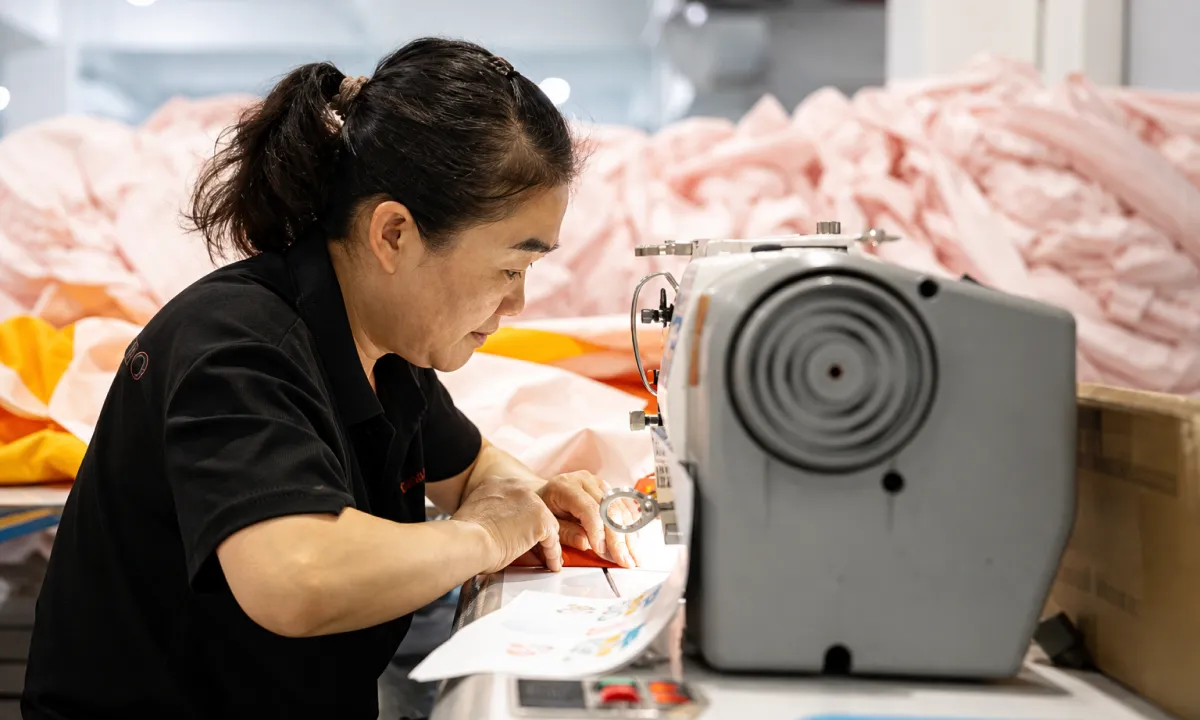
- Stitching. Panels rarely fail in the middle; seams fail first. In our own production, every seam is double-stitched, with bar tacking added at stress points, handled by a sewing crew of more than 50 workers. Seam quality is capacity.
- Blower. The blower must move enough air to hold the structure rigid at maximum load, so its airflow rating has to match the chamber volume. An undersized blower lets walls sag and the floor bottom out, and an overloaded unit usually deflates because a seam has burst or the blower is overwhelmed.
If the rating of a unit looks too good for its size and price, one of these five was reduced to get there.
Typical Bounce House Weight Limits by Type
Across the industry, small backyard castles typically carry 300 to 500 pounds, mid-size commercial units 600 to 800 pounds, and large commercial castles 800 to 1,200 pounds, with premium builds rated higher. Combo units assign a separate, lower limit to the slide section. The label on your specific unit always overrules any general range.
| Unit type | Typical size | Typical total weight limit | Practical occupancy |
|---|---|---|---|
| Backyard kids castle | 10-13 ft | 300-500 lbs | 4-6 children |
| Mid-size commercial castle | 13-15 ft | 600-800 lbs | 6-10 children, or 3-5 adults |
| Large commercial castle | 15 ft and up | 800-1,200 lbs, premium builds to about 1,500 lbs | 8-12 children, or 4-6 adults |
| Combo unit with slide | 15-20 ft | 600-1,000 lbs total, slide rated separately and lower | Rotate jumpers and sliders |
| Obstacle course | 30 ft and up | Rated per section, load spread along the length | Participants keep moving; follow per-lane limits |
These ranges are typical figures across commercial spec sheets, useful for planning purchases and rental schedules. Two design notes matter here. Units built for water use are often rated higher, because water absorbs impact energy that a floor would otherwise take. Obstacle courses spread the load along their length, so their limits are published per section rather than as one big number. In every case, the rating label and manual for your unit govern, not a table on the internet.
How Manufacturers Test Inflatable Safety and Load Capacity
Reputable manufacturers combine material burst and tensile testing, seam pull testing, dynamic load simulation and air-pressure checks at maximum rated load. The published limit then sits roughly 20 to 30 percent below the tested failure point. That margin absorbs uneven weight distribution, simultaneous jumping and gradual material fatigue over years of rentals.
- Material burst strength: the pressure at which the fabric fails.
- Seam pull strength: the force stitched or welded seams withstand before separating.
- Dynamic load factor: jumping multiplies body weight two to three times, so static ratings alone would fail in real use.
- Air pressure tolerance: the airflow required to keep the unit rigid at full rated load.
In many markets, commercial inflatable play equipment is built and inspected against EN 14960, the standard covering design, materials and anchoring for inflatables in public use. Asking a supplier which standard their units are tested to, and for the paperwork behind it, tells you more than any catalog photo.
Testing should not end at design approval. Every inflatable that leaves our Wenzhou facility passes a full 24-hour inflation test before shipment, covering air retention, seam integrity, structural balance, and color consistency under both daylight and artificial lighting. Blowers are assembled and matched to each unit inside the same 12-step production workflow, so the airflow rating on paper is verified on the actual product.
How to Choose a Commercial Inflatable for Your Business
Buy for your busiest day, not your average one. Plan real occupancy at 70 to 80 percent of the rated total, convert that into per-person limits with realistic body weights, and match material, stitching and blower specs to your rental frequency. Then enforce the limit in your contract, on a placard, and during every delivery briefing.
- Apply the 70-80% rule. A unit rated at 800 pounds should run at roughly 560 to 640 pounds of actual occupant weight, leaving room for dynamic load and uneven distribution.
- Use realistic planning weights. Children aged 3-7 average 40-60 pounds, ages 8-12 run 60-100 pounds, teenagers 100-150, and adults 150-200. Mixed-age events need group rotation, because adults and small children should never jump at the same time.
- Match build quality to duty cycle. A unit renting every weekend needs commercial-grade fabric, double-stitched seams and a spare blower on the truck. An occasional-use unit can sit lower on the spec ladder.
- Demand documentation. Ask for spec sheets, test records, a repair kit and a maintenance schedule with every purchase. Our inflatable maintenance guide covers the upkeep that keeps ratings valid season after season.
- Think beyond standard sizes. If your events call for oversized or branded structures, a custom giant inflatable engineered to your venue and crowd plan carries a documented capacity instead of a generic one.
A bounce house weight limit only protects your customers and your business when it is specified honestly, posted clearly and enforced on site. If you are sourcing commercial inflatables for a rental fleet or an event program, send us your venue dimensions, expected occupancy and usage frequency. Our team will recommend the material, structure and blower configuration for your duty cycle, and come back with a design proposal and quotation within 24 to 48 hours.
FAQ
Yes. Every commercial bounce house carries a rated weight limit set by the manufacturer after material, seam and airflow testing. You will find it on the label near the entrance, on the spec sheet and in the user manual. If a second-hand unit has lost its label, ask the manufacturer for the spec sheet before renting it out.