Giant Inflatable Animals: From Dinosaurs to Pandas
Giant inflatable animals do one job better than almost any other display format: they make a venue impossible to walk past. A ten-metre T-Rex at a museum entrance, a life-size blue whale suspended over an atrium, a giant panda on a city waterfront — forms like these read from hundreds of metres away, pull foot traffic toward them, and hand every visitor a photo worth sharing. This guide covers the main categories, from dinosaurs to pandas to marine life. It explains the difference between realistic and cartoon builds, how realistic animals are actually manufactured, and what it takes to size, light and anchor them outdoors. It is written from the workshop floor: 360 Inflatable has spent two decades building custom animal forms for museums, theme parks, zoos and brand campaigns.
Realistic vs. cartoon: decide the goal first
The first decision is style, because it drives modelling, materials, printing and cost. A realistic inflatable animal reproduces anatomy, surface texture and colour as faithfully as fabric allows: scale patterns, fur shading, muscle volume, correct skeletal proportion. A cartoon or mascot-style build simplifies the same animal into a rounded, friendly character. Neither is better. They answer different briefs.
| Decision factor | Realistic build | Cartoon / mascot build |
|---|---|---|
| Goal | Immersion, education, awe | Warmth, approachability, brand affinity |
| Best venues | Museums, zoos, science centres, aquariums | Retail, family events, brand activation |
| Surface treatment | Printed texture, shading, anatomical detail | Flat colour, bold simplified shapes |
| Visual read | Impressive, sometimes intimidating | Friendly, huggable |
| Typical buyer | Curators, exhibit designers | Marketers, event agencies |
A natural history museum needs a creature its curators will approve. A shopping mall usually needs a soft character children want to photograph and hug. Fix the goal first, and the style follows on its own.
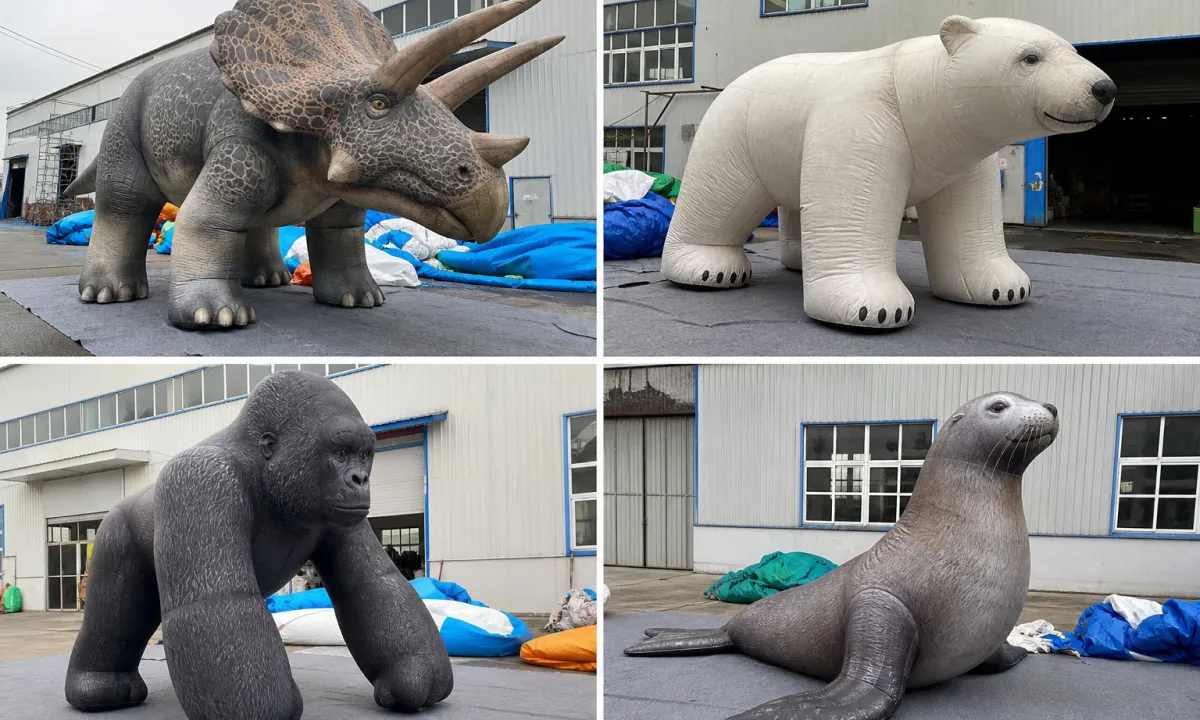
Dinosaurs: the most requested category
Dinosaurs dominate realistic animal orders for a simple reason: everyone recognises them, and no one can see them any other way. The staple species are Tyrannosaurus rex, Triceratops, the long-necked Brontosaurus and the winged Pterosaur. Velociraptor appears often at 1:1 scale for indoor galleries. T-Rex builds typically stand 3 to 8 metres tall, while long-bodied sauropods are measured by length and pass 15 metres without engineering drama.
Logistics are the quiet advantage. A giant inflatable dinosaur folds into a crate and inflates in minutes, so a travelling exhibition can restage the same set city after city. Compared with fibreglass statues or animatronics, freight and install costs drop sharply. Science centres, school programmes and theme-park zones all run on this math. Outdoors, the same species scale up further: a 12 to 15 metre sauropod or T-Rex at an exhibition gate works as the landmark that visitors navigate by.
The panda and regionally iconic animals
The giant panda is the strongest single animal form for cultural events and brand work in Asian markets. As a China-based manufacturer, we have built large panda installations for waterfronts and festivals, where the black-and-white form reads instantly and photographs well from any angle. Panda briefs split in two directions: realistic replicas for education and conservation themes, and softer cartoon versions for retail and brand campaigns.
Other regionally iconic animals follow the same rule. A recognisable local symbol at giant scale becomes the landmark of the site, whether that is a tiger for a jungle-themed zone, a koi for a waterside festival, or an elephant for a safari promotion. For brands entering the Chinese market, a giant panda is often the fastest way to signal locality and gather a crowd.
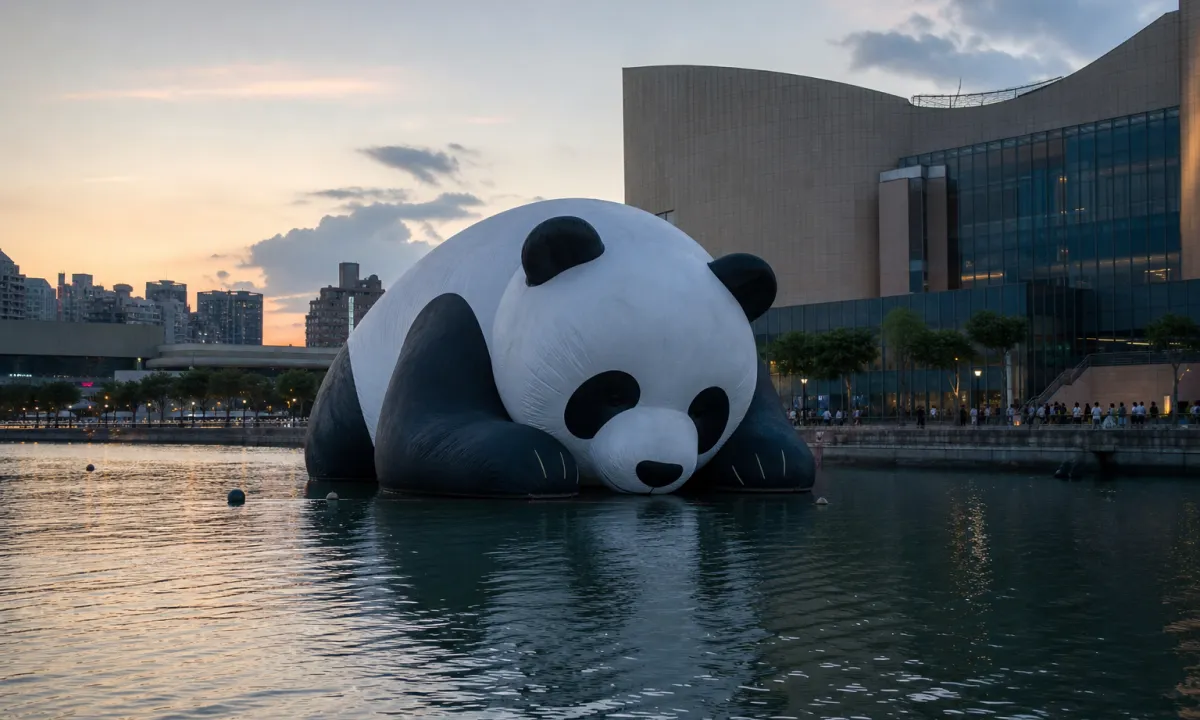
Marine life and wildlife
Beyond dinosaurs, the realistic catalogue spans ocean and land. Whales, sea turtles and sharks suit aquariums, ocean-themed exhibits and suspended atrium displays, where a large marine form overhead gives visitors the feeling of walking underwater. Suspended pieces are planned around the venue's hanging points and load limits, which is an engineering conversation to have early. Land wildlife — polar bears, gorillas, sea lions, elephants, big cats — fits zoos, conservation campaigns and awareness events.
In these venues the realistic build earns its budget through education. A life-size whale communicates scale in a way no diagram or screen can. That is why museums and science centres commission anatomically accurate pieces instead of generic cartoon versions.
How realistic inflatable animals are made
Realism comes from process, not luck. Each build moves through controlled stages, and skipping any of them shows in the finished animal.
- Anatomical reference and 3D modelling. The animal is modelled from scientific reference — paleontological data for extinct species — so proportion and posture are right before any fabric is cut.
- Pattern cutting. The model is unwrapped into 50 to 200+ fabric panels, with seams routed along natural anatomical lines so the inflated form holds its shape.
- Dye-sublimation printing. Texture, shading and colour are printed directly into the panels, with far more detail and repeatability than hand airbrushing.
- Sewing and reinforcement. Panels are double-stitched, with bar tacking at claws, fins, joints and other stress zones.
- Hand finishing. Eyes, teeth and claws get individual attention, because these are the details visitors inspect up close.
- Sealing and inflation testing. A protective coating guards the print against UV, scratching and fading, and every piece is inflated and inspected before it ships.
Material choice follows the species. Oxford fabric covers most outer skins; long plush adds real fur texture where touch matters; PVC variants handle glossy or translucent effects. All of it is waterproof and flame-retardant, with CE and UL certification available. In practice, pattern accuracy plus printed texture is what separates a convincing creature from a lumpy balloon.
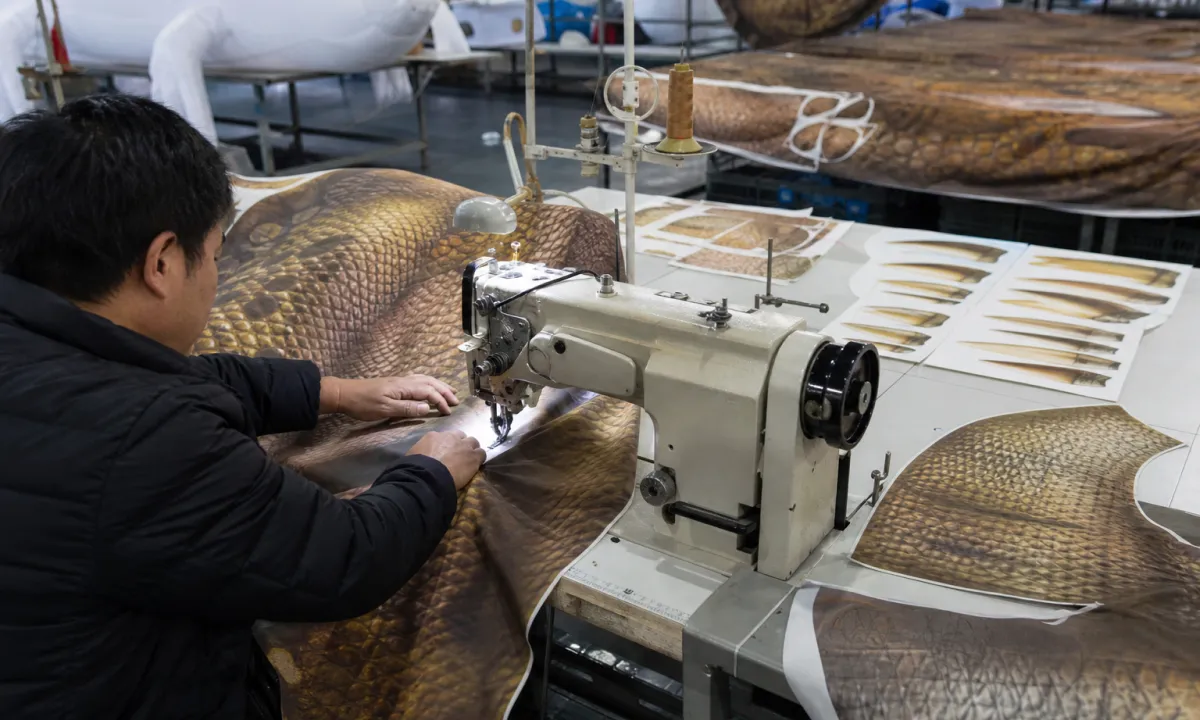
Inflatable vs. animatronic: which one fits your project
Buyers planning a dinosaur or animal attraction usually weigh inflatables against animatronics. The two solve different problems.
| Factor | Inflatable animal | Animatronic animal |
|---|---|---|
| Movement and sound | Static, optional LED lighting | Motorised motion, roaring, sensors |
| Scale | Easily giant, 10 m and beyond | Usually life-size, weight-limited |
| Transport | Light, folds into crates | Heavy, rigid, complex freight |
| Setup | Minutes with a blower | Longer technical installation |
| Maintenance | Low: blower and fabric care | Higher: motors, electronics, servicing |
| Best for | Landmarks, touring shows, seasonal displays | Permanent attractions that need motion |
If a permanent attraction needs a creature that moves and roars, animatronics are the right tool and worth the budget. Many venues run both: animatronics for the close-up encounter, a giant inflatable for the landmark and the photo moment.
Sizing, materials and outdoor deployment
Custom animal builds scale from 0.5 metres to more than 30 metres. The right size comes from viewing distance: a plaza or rooftop piece needs height to read from the street, while an indoor gallery piece is capped by ceiling height and hanging points. Most animals run on a continuous blower sized to the internal volume, with 110V and 220V versions for different markets, and set up in five to fifteen minutes.
Outdoor deployment is an engineering question. Pieces anchor with stakes, ropes, sandbags or weighted bases, and a fully anchored build handles wind up to about 38 km/h. Above that threshold the correct move is to deflate and wait. Waterproof fabric shrugs off rain; the blower keeps running. For evening programmes, internal LED lighting turns a dinosaur or whale into a night-time landmark, which suits night markets, evening museum hours and festival sites.
Where giant inflatable animals fit
The core venues are museums and science centres, zoos and aquariums, theme parks, travelling exhibitions, and brand activations or city festivals. In educational settings the realistic build carries the message: accuracy does the teaching. In retail and event settings the same animal, realistic or cartoon, becomes the crowd magnet and photo backdrop.
Placement decides performance. Indoors, position a realistic creature along the visitor route where people approach slowly. Outdoors, size the piece to the sightline of passing traffic and make it the obvious photo spot. Grouping several animals into a themed set, instead of placing one figure alone, turns a display into an environment and keeps visitors on site longer.
One more practical note: because the piece is reusable, buying usually beats renting after the second or third deployment. A museum can restage a dinosaur programme every season, and a brand can redeploy the same animal across a multi-city activation calendar while the cost per appearance keeps falling.
Build the animal your venue needs
From a scientifically accurate dinosaur to a soft, photogenic panda, the right giant inflatable animal comes down to goal, venue and audience. We design, model, print and sew realistic and cartoon inflatable animals at any scale, with the pattern accuracy and material durability that repeated deployment demands. Production typically runs 20 to 40 days depending on size and finish, and every project starts with a 3D preview for approval. Tell us the species, the size and where it will stand, and 360 Inflatable will recommend the build, material and deployment plan to bring it to life.
FAQ
Custom builds run from about 0.5 metres to more than 30 metres. Upright forms like a T-Rex are measured by height; long-bodied animals like a brontosaurus or a whale are measured by length. The right size depends on viewing distance outdoors and ceiling height indoors.