Burning Man Art in the Real Dust: How We Installed a Giant Inflatable at Black Rock City
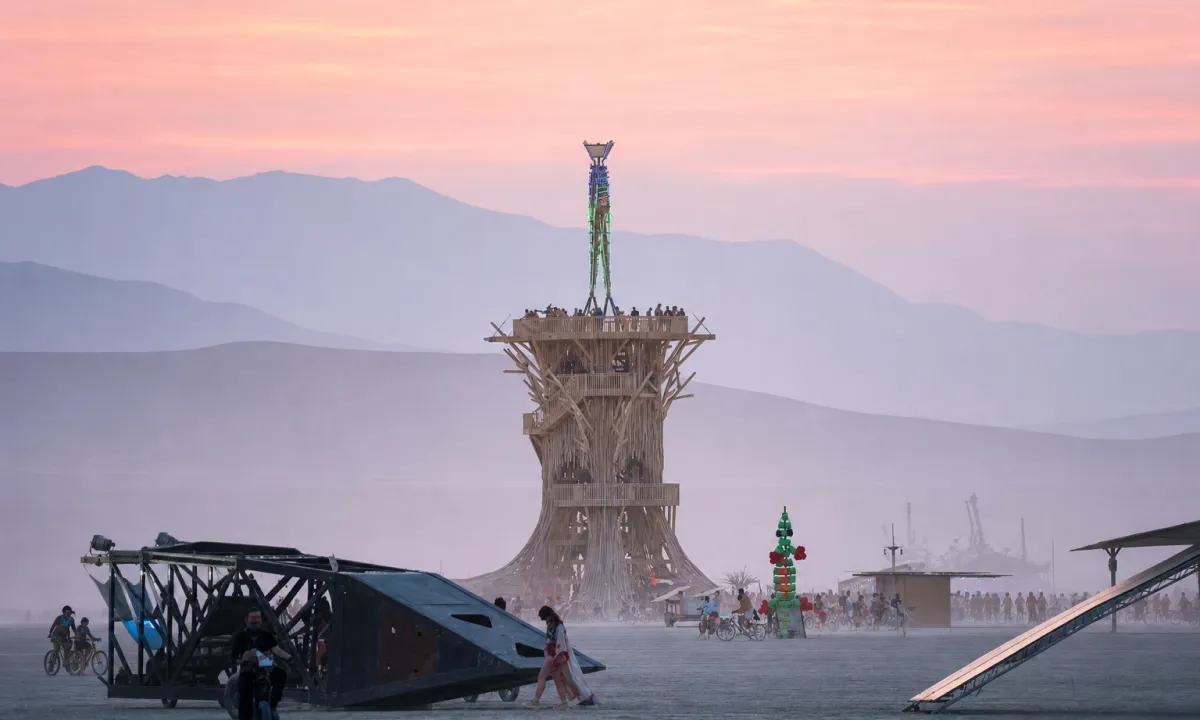
Burning Man 2026 ran from August 30 to September 7 in Nevada's Black Rock Desert. Under this year's theme, Axis Mundi, roughly 400 temporary art installations went up on the playa for more than 70,000 participants, according to pre-event media reports. Every one of them faced the same conditions: corrosive alkaline dust, sudden storm gusts, hard temperature swings, and no grid power. For burning man art, surviving the week is an engineering outcome, not luck. Our team spent that week on site, responsible for keeping one installation standing: EMO (Yi Mao) 一毛, a giant pink inflatable character by artist Jiang Heng (GAN).
Burning Man 2026: More Than a Party, an Extreme Test Ground for Public Art
Black Rock Desert imposes four stresses on any outdoor structure at once: corrosive alkaline dust, sustained wind with sudden storm gusts, day-night temperature swings, and zero permanent infrastructure. Installations run unattended around the clock for a full week. Any material or engineering weakness shows up within days, sometimes within hours.
Every year the event produces striking coverage of sculptural timber temples, mirrored towers, and kinetic steel. Design media like Dezeen document the visual side well. What those roundups rarely cover is the operational reality behind each piece. A desert art installation has no walls to shelter behind, no grid power to plug into, and no facility crew on call. If a seam fails or an anchor pulls loose at 2 a.m. in a whiteout, the team that built it is the only support that exists.
For context, here is how the playa compares with the environments most event buyers plan for:
| Condition | Typical Festival or City Installation | Burning Man (Black Rock Playa) |
|---|---|---|
| Wind exposure | Occasional gusts, some shelter from buildings or staging | Sustained wind plus sudden dust storms, fully open terrain |
| Dust and abrasion | Normal urban or grass environments | Fine alkaline dust that abrades coatings and clogs equipment |
| Temperature | Moderate daily swing | Hot days, near-freezing nights, repeated daily cycling |
| Power supply | Grid or event power distribution | Generators only; everything must be brought in |
| Staffing | Event crew and vendors on site | Self-supported; the install team is the entire safety net |
| Duration | Hours to a long weekend | Continuous operation for seven days or more |
Treat this table as the starting specification for any inflatable heading into a harsh environment. Each row changes a design decision, and three of them carry most of the weight: anchoring, fabric and coating, and the power chain. The next section breaks down how we handled each of the three on this project.
Our Part in This Year's Burning Man Art: EMO (Yi Mao)
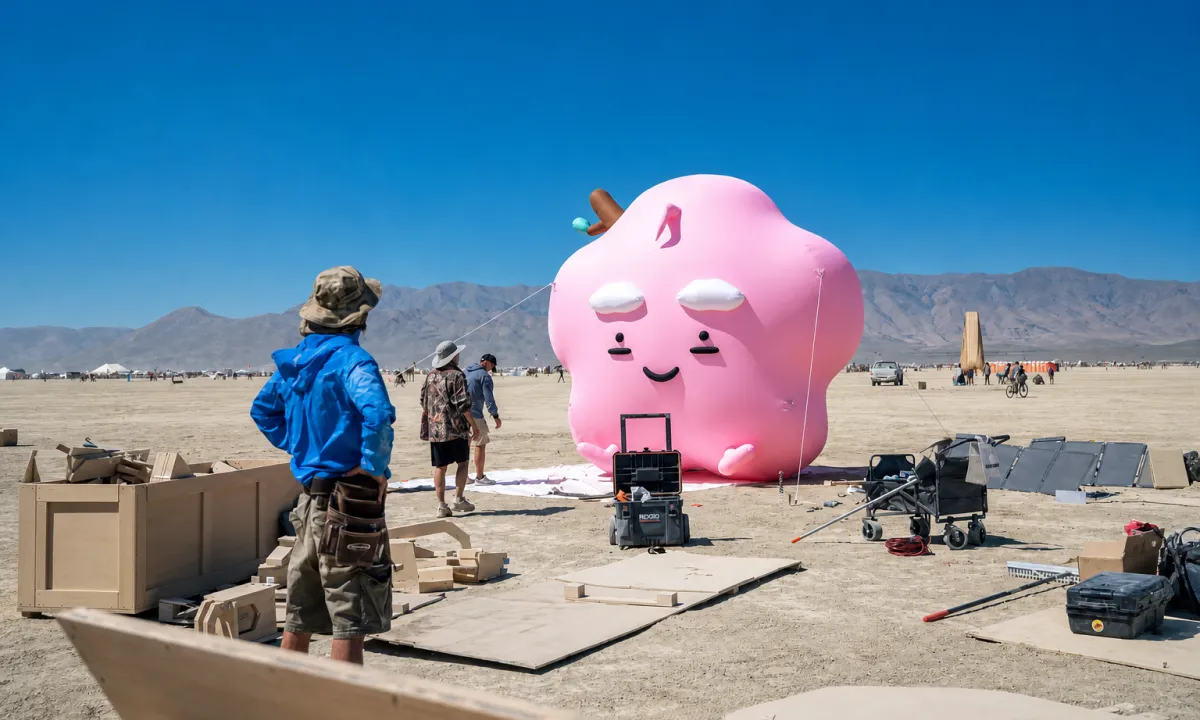
EMO (Yi Mao) is a giant pink character inflatable artwork created by artist GAN (Jiang Heng). Our team was responsible for the full engineering and manufacturing workflow: translating the artist’s conceptual design into production patterns, completing full-scale sculpt fabrication, and providing professional on-site technical support during field installation.
Exhibited at the Lizard Camp showcase during Burning Man, this artwork was fully exposed to the extreme desert operating conditions outlined in the table above. Below, we break down the core engineering essentials for desert-deployed inflatable installations, including professional anchoring systems, specialized material selection, and on-site power deployment solutions.
Desert Deployment: How We Kept a Giant Inflatable Standing for 7 Days
Keeping a constant-air inflatable operational on the playa comes down to three systems: anchoring matched to the ground, fabric and coating matched to the dust and UV, and a blower-plus-power chain with real redundancy. Get all three right and the piece runs unattended. Miss one and the desert finds it.
Anchoring on ground you cannot trust
Playa surface is a hard crust over soft, silty sediment, and its holding strength varies meter by meter. Standard tent stakes are decorative in these conditions. Our approach combines long steel anchors driven at an angle, load-spread guy lines attached to reinforced anchor points on the sculpture body, and ballast where the soil report says driving is unreliable. Every attachment point on the inflatable itself is an engineered connection, webbing-reinforced and rated above the calculated wind load for the piece's sail area. The photo of our crew member bracing a guy line in a dust storm is not staged. That line, and a dozen like it, is what seven days of uptime actually looks like.
Fabric, coating, and the alkaline dust problem
Playa dust is alkaline, extremely fine, and electrostatically clingy. It works into seams, abrades print surfaces, and degrades coatings that were never specified for it. For desert deployment we select coated fabrics with UV-stable, abrasion-resistant surfaces, and we adjust print and coating processes so graphics survive a week of scouring without visible fade. Seam construction matters as much as fabric choice: dust infiltration through a weak seam shows up as slow pressure loss that nobody notices until the sculpture starts to sag in front of an audience.
Blowers and power where there is no grid
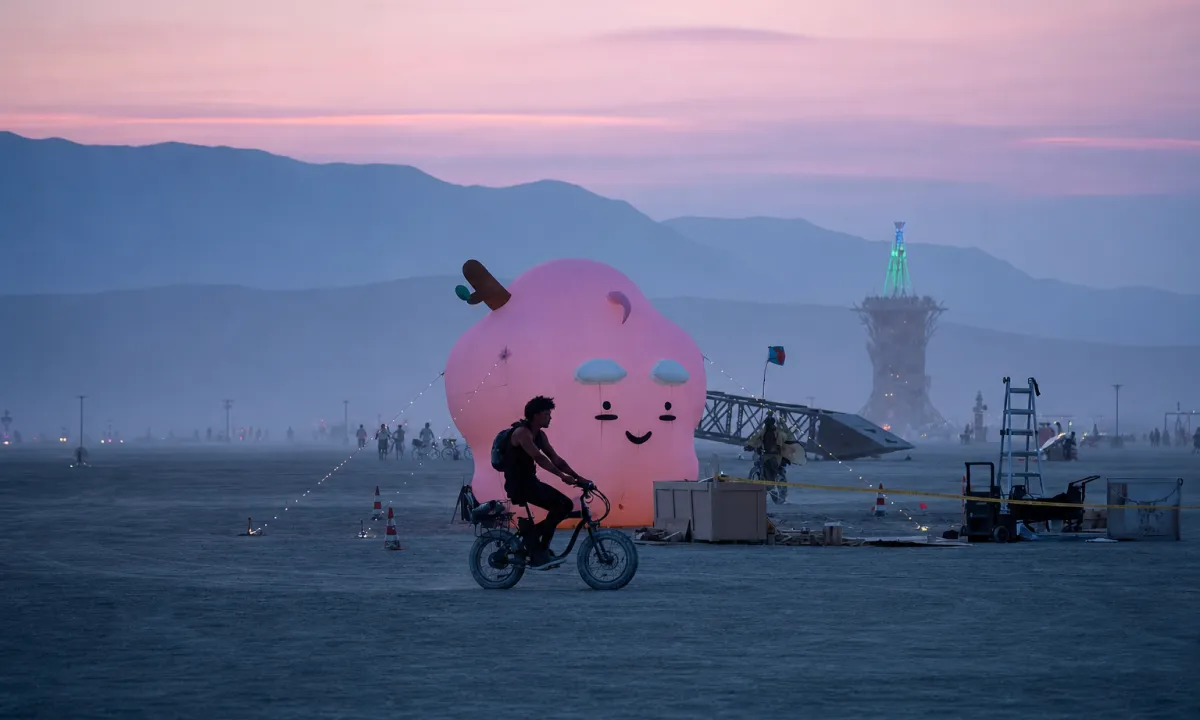
A constant-air inflatable is only as reliable as its air supply, and on the playa that supply runs on generators you bring yourself. We specify blower capacity with headroom above the sculpture's steady-state demand, because dust-loaded filters and daytime heat both eat into performance. The power chain gets redundancy at every link: primary and backup blower capacity, fuel planning for the full run time, and protected cable routing so a passing art car cannot take the piece down. When the dust storm in our photos rolled through, the system that mattered most was the one nobody could see.
The Payoff: EMO Standing Through the Storm
Seven days. Multiple dust events. Near-freezing nights after hot afternoons. EMO stayed inflated, kept its shape and color, and became exactly what the artist intended: a soft landmark that participants photographed, leaned against, and gathered around at sunrise and sunset. The dusk images from the playa, pink figure against a pink sky with cyclists drifting past, are the result we were hired to protect.
For us as a manufacturer, this is the strongest kind of reference. A custom giant inflatable that survives Black Rock City has passed a field test no laboratory can fully simulate. When clients ask whether our work can handle a coastal festival, a desert brand activation, or a week-long outdoor exhibition, we now answer with photographs instead of adjectives.
None of this happens without close coordination between artist and factory. The collaboration process behind EMO followed the same path we use with commercial clients, and if you are evaluating a similar project, our guide on how to order a custom inflatable walks through that workflow step by step.
What This Means for Your Next Festival Art Installation
Festival and event season keeps expanding, and demand for large-scale inflatable art installation work is expanding with it. If you are sourcing an inflatable for an outdoor festival, art program, or desert event, the lessons from this project translate directly into a buying checklist:
- Specify the environment, not just the sculpture. Share wind exposure, ground type, dust, and temperature range with your manufacturer at the brief stage. These inputs drive fabric, coating, and anchoring decisions.
- Ask how anchor points are engineered. The connection between guy line and sculpture body is where field failures concentrate. Look for webbing reinforcement and rated hardware.
- Treat air supply as a system. Blower sizing, filter maintenance in dusty air, and power redundancy belong in the quote, not in an afterthought.
- Plan for unattended operation. If the piece must run for days without supervision, say so. It changes seam specification, blower selection, and the monitoring plan.
- Check the manufacturer's field record. Ask where their work has actually been installed and for how long. Survived environments are better evidence than material datasheets alone.
As 360 Inflatable, this is the work we do every season: custom inflatable art and large-scale inflatables engineered for the conditions they will actually face. If you are planning an inflatable art piece for a festival, exhibition, or any outdoor program, send us your concept and site conditions, and we will come back with a manufacturable plan, material recommendations, and a realistic timeline. The next piece of burning man art that makes it through a desert storm could be the one you are sketching right now.
FAQ
Yes, if it is engineered for the environment. Dust storms on the playa combine sustained wind with fine alkaline abrasion. An inflatable specified with reinforced anchor points, abrasion-resistant coated fabric, and a redundant blower chain can run through repeated storms. Our EMO installation at Burning Man 2026 stayed operational through multiple dust events across seven days.