Giant Inflatable Materials Explained: What They're Made From and How to Judge Quality
When clients ask about inflatable materials, the answer they usually get is "Oxford fabric" or "PVC" — and that's where most supplier conversations stop. The problem is that both of those terms cover a huge range of actual specifications, and the difference between a 210D Oxford inflatable and an 840D Oxford inflatable is the difference between something that lasts one season and something that runs for five years.
This guide covers what large inflatables are actually made from, what the specs mean in practice, and what to look for when you're trying to judge whether a supplier is building to the standard they're quoting.
Oxford Fabric: The Standard Choice
Oxford fabric is the most common material for large outdoor inflatables used in advertising, events, and artistic installations. It's a woven nylon base fabric with a PVC or TPU coating applied to the surface.
The number before "D" — as in 210D, 420D, or 840D — refers to the denier count of the yarn. Higher denier means thicker yarn, denser weave, and heavier fabric. In practical terms:
- 210D Oxford: Lightweight, lower cost. Used for short-term indoor displays, single-event decorations, small promotional pieces. Not suitable for extended outdoor use.
- 420D Oxford: The middle range. Good balance of weight and durability. Suitable for most commercial event inflatables, seasonal deployments, standard advertising builds. Most quality commercial inflatable arches and mid-size builds use 420D.
- 840D Oxford: Heavy-duty. Used for large outdoor inflatables designed for extended deployment, multiple pack-and-deploy cycles, or harsh weather environments. The fabric weight is roughly double 420D, and it shows in both durability and cost.
The coating matters as much as the base fabric. PVC coatings vary in thickness and formulation — a thin, poorly adhered coating will peel and crack under UV exposure within one season. TPU coatings are more flexible and durable than standard PVC, especially in cold weather, but cost more. For inflatables that will be deployed outdoors for extended periods, coating quality is often the limiting factor for lifespan, not the base fabric.
A note on weight: the fabric weight stated in grams per square meter (gsm) gives you a more precise comparison than denier alone. Quality 420D Oxford typically runs 280–320 gsm; quality 840D runs 500–600 gsm. If a supplier can't tell you the gsm of their fabric, that's worth noting.
PVC-Coated Fabric: When Airtightness Is the Priority
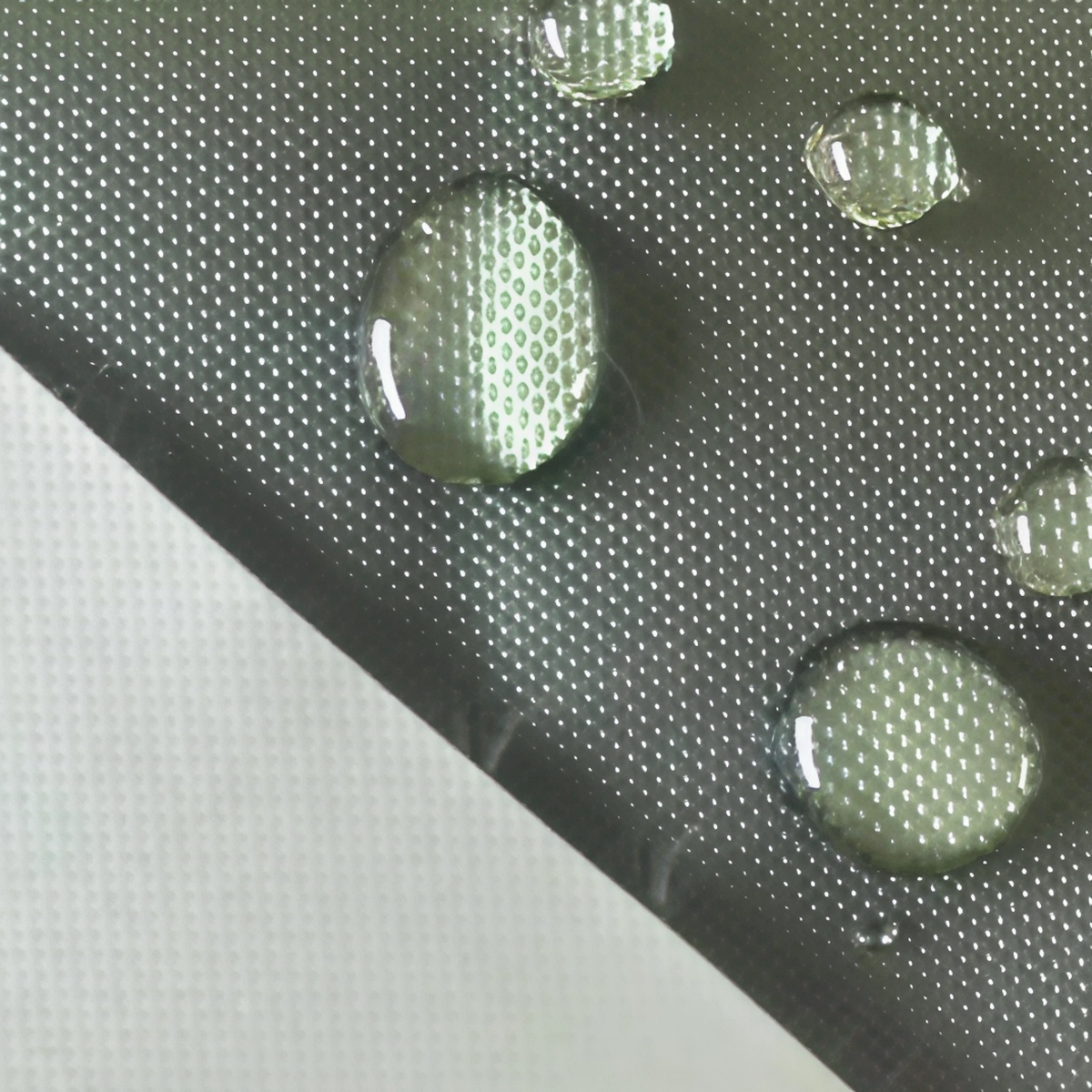
Heavy PVC fabric — the kind used for inflatable boats, waterslides, and airtight bladders — is a different product from Oxford fabric with a PVC coating. It's a PVC film laminated to a polyester mesh substrate, typically ranging from 0.4mm to 1.0mm in thickness.
When to use heavy PVC:
- Inflatables that need to stay inflated for extended periods without continuous blower operation (sealed inflatables vs. open-airflow inflatables)
- Water-contact deployments where long-term moisture resistance is critical
- High-traffic environments where puncture resistance matters
- Projects where the surface needs to be very smooth for specific visual effects
The trade-off is weight and flexibility. Heavy PVC is significantly heavier than Oxford fabric, which affects both shipping cost and on-site handling. It's also less flexible for complex paneling — compound curves are harder to achieve cleanly with thick PVC than with Oxford, which is why most character and sculptural inflatables use Oxford even when they need weather resistance.
Thickness ratings for PVC are not all equal. The thickness figure doesn't account for the quality of the PVC compound or the strength of the polyester mesh substrate. A 0.6mm PVC from a reputable supplier can outperform a 0.9mm product from a low-cost source in both tear resistance and UV stability.
Specialty Materials
Beyond Oxford and PVC, several specialty materials are used for specific visual or functional requirements:
Long-Plush Fabric
Long-plush (毛绒布) is sewn as a surface overlay onto an Oxford base structure. It gives inflatables a tactile, soft appearance that reads very differently in photography from smooth Oxford — the pile catches light in a way that adds visual depth and makes the piece look more like a stuffed toy than an inflatable.
It's primarily used for character inflatables where the brand aesthetic is defined by softness (Jellycat-style builds being the clearest example), seasonal mascots, and premium installations where surface texture is part of the design intent. The challenge is color consistency: plush pile takes dye differently from woven Oxford, so color-matching between plush and printed Oxford sections requires careful sampling before production.
Mirror PVC
Mirror PVC is a metallic-coated PVC film that produces a highly reflective surface. It's used for inflatables where the reflective quality is the visual intent — the piece changes appearance with lighting and viewing angle in a way matte Oxford cannot.
The engineering limitation is that mirror PVC has lower elasticity than Oxford. It doesn't stretch or ease around curves the way Oxford does, which means complex curved forms are harder to panel cleanly. Experienced fabricators manage this by designing the panel geometry specifically for the material's behavior, but it adds design and production complexity.
Transparent and Translucent PVC
Clear or frosted PVC is used for inflatables where internal elements — LED lighting, suspended objects, flowers, colored liquids — need to be visible through the surface. It's technically challenging because transparent PVC shows every seam, every panel edge, and any internal structure — there's no visual tolerance for imprecision the way matte Oxford provides.
Translucent white PVC is more forgiving than clear, and diffuses LED light more evenly, which is why it's often preferred for LED-integrated builds over fully transparent material.
Flame-Retardant Certified Fabric
For indoor deployments in venues with fire safety compliance requirements, flame-retardant (FR) certified fabric is required. The relevant standards vary by market: CPAI-84 (US), BS5438 (UK), EN13501 (EU). These certifications apply to the fabric and coating combination, not just the base material — a standard Oxford with FR treatment applied after the fact may not meet certification standards, depending on how it's tested.
Specify the required standard at the quoting stage. Not all suppliers stock FR-certified fabric in all specifications, and sourcing it can add 1–2 weeks to the production timeline.
How to Match Material to Your Project
| Project Type | Recommended Material | Key Reason |
|---|---|---|
| Short-term indoor event (1–3 days) | 210D–420D Oxford | Cost-effective, easy to handle |
| Outdoor event activation (1–4 weeks) | 420D Oxford with UV coating | UV and abrasion resistance for extended outdoor use |
| Seasonal / multi-cycle deployment | 840D Oxford | Withstands repeated pack-deploy cycles |
| Long-term outdoor landmark (months) | 840D Oxford or 0.6–0.9mm PVC | Maximum durability and UV stability |
| Water deployment | 0.6mm+ PVC | Airtightness and moisture resistance |
| Soft/plush character aesthetic | 420D Oxford + plush overlay | Visual softness at scale |
| Reflective / metallic visual | Mirror PVC panels on Oxford base | Reflective surface with structural flexibility |
| LED glow effect | Translucent white PVC or mid-weight Oxford | Even light diffusion through fabric |
| Indoor venue with fire code requirements | FR-certified fabric (specify standard) | Compliance with venue safety regulations |
What Separates High-Quality from Low-Quality Inflatables
Material specification is only one part of the quality equation. How the material is used — the seam construction, the panel engineering, the finishing details — often matters more than the fabric grade.
Seam Construction
Large fabric inflatables are sewn, not heat-welded. The stitch type and thread specification directly affect how long the seams hold under continuous air pressure and outdoor stress. Quality commercial inflatables use double-lock stitch or reinforced triple-stitch at load-bearing seams. Bar-tack reinforcement is applied at high-stress points — base corners, anchor attachment points, air valve surrounds.
A useful check: ask to see a cross-section of a seam sample, or examine the seam allowance on a finished piece. Wide seam allowance with clean stitching indicates a well-engineered product; narrow, uneven seaming with loose thread ends is a reliable indicator of production shortcuts.
Air Valve Quality
Valves are the most common failure point on commercial inflatables. Low-cost valves use thin plastic components that crack under UV exposure and loosen with repeated use. Quality builds use reinforced nylon or metal-reinforced valves with double-sealed attachment to the fabric. For inflatables designed for multiple deployment cycles, high-cycle-rated valves specified from the start are worth the additional cost.
Print Quality
Digital printing on Oxford fabric requires color profiling specific to the substrate — colors calibrated for screen or paper will not match on matte Oxford without ICC profile adjustment. Low-cost suppliers skip this step, which results in prints that look significantly different from approved artwork, particularly in midtone accuracy and color saturation.
UV-stable ink is essential for anything deployed outdoors. Standard solvent inks will show visible fading within 3–6 months of outdoor exposure. Eco-solvent or UV-cured inks maintain color stability significantly longer. Ask suppliers which ink system they use for outdoor prints.
Inflation Testing
Every inflatable should be fully inflated and inspected before it ships. This is not universal practice at lower price points. A proper inflation test checks seam integrity under operating pressure, form accuracy against the approved 3D reference, valve function and air retention rate, and print registration across the assembled piece.
If a supplier cannot confirm that your piece was inflation-tested before shipping, that's a risk flag — problems discovered on installation day are significantly more expensive to resolve than problems caught in the factory. See how our production facility handles quality control at every stage.
Warning Signs in Inflatable Production
Based on years of factory experience, these are the most common indicators of a production quality problem:
- Fabric odor after unpacking: Strong chemical smell that persists more than a few hours often indicates low-grade PVC coating or poorly cured ink. Not always a safety issue, but a quality indicator.
- Seam lines that don't run straight: Crooked seaming indicates either poor pattern engineering or unskilled production. Both lead to form distortion under pressure.
- Thin print color on dark areas: If black or deep color areas look streaky or uneven, the print pass count was too low. The piece will look worse after UV exposure.
- Valves that don't seal cleanly: Any valve that requires physical pressure to hold shut on a new piece will get worse with use.
- Form that doesn't match the approved 3D: If the assembled piece looks noticeably different from the approved artwork — proportions off, curves not hitting the right shape — the paneling was done incorrectly. This cannot be fixed after production.
How Long Should a Well-Built Inflatable Last?
A well-specified outdoor inflatable built with 840D Oxford, UV-stable inks, and quality seam construction will typically last 3–7 years under regular outdoor deployment. The main variables are UV exposure intensity (geographic location), deployment frequency, and storage conditions between deployments.
Properly stored inflatables — clean, dry, folded without sharp creases, kept out of direct sunlight — significantly outlast pieces stored carelessly. Fold lines are the most common site of fabric fatigue; inflatables designed for multiple deployment cycles should be folded consistently at the same points, which is why good suppliers provide folding instructions with the product.
A realistic lifespan benchmark: a well-built commercial inflatable should complete 10–20 deployment cycles over 3–5 years before showing meaningful degradation in visual quality. Budget builds using 210D fabric and standard inks often show visible wear within 1–2 seasons of outdoor use.
Have a Specific Project in Mind?
We've been manufacturing large inflatables since 2006, across commercial advertising, brand activations, artistic commissions, and large-scale public installations in 40+ countries. Material selection is one of the first conversations we have with every client — because getting it right at the spec stage is the only way to ensure the piece performs the way it's supposed to.
If you have a project brief, a reference image, or just questions about which material fits your deployment, here's how we work — send it over. We'll give you a straightforward recommendation within 24 hours.
FAQ
Most large commercial and artistic inflatables are made from Oxford nylon fabric with a PVC or TPU coating — typically 420D or 840D denier weight depending on the application. Heavy PVC-coated fabric (0.4–1.0mm) is used for water deployments and sealed inflatables requiring maximum airtightness. Specialty applications use long-plush fabric overlay, mirror PVC, transparent PVC, or flame-retardant certified materials for specific visual or compliance requirements.
Oxford fabric (nylon base with PVC or TPU coating) is lighter, more flexible for complex curved shapes, and better suited for digital printing. It's the standard for most event, advertising, and artistic inflatables. Heavy PVC fabric (PVC film on polyester mesh) is denser, more airtight, and more moisture-resistant — used for water deployments, sealed inflatables, and applications where air retention over extended periods without a blower is required. Oxford is generally easier to work with for complex forms; PVC is preferred when airtightness is the primary requirement.
For Oxford fabric, weight in grams per square meter (gsm) is a more useful measure than denier alone. Quality 420D Oxford runs 280–320 gsm and is appropriate for most commercial event inflatables. Quality 840D Oxford runs 500–600 gsm and is used for extended outdoor deployments, landmark builds, and pieces designed for 10+ deployment cycles. For PVC fabric, 0.4–0.5mm is appropriate for lighter-duty applications; 0.6–0.9mm for commercial outdoor and water applications.
High-quality inflatables combine appropriate material specification with quality seam construction (double-lock or triple-stitch with bar-tack reinforcement at stress points), UV-stable printing inks, quality air valves rated for the intended use cycle, and a pre-shipment inflation test that checks seam integrity, form accuracy, and valve function. Material grade is one factor; how the material is used in production is equally important.
A well-built outdoor inflatable using 840D Oxford fabric, UV-stable inks, and quality seam construction typically lasts 3–7 years under regular deployment. The main variables are UV intensity, deployment frequency, and storage conditions. Pieces stored clean and dry between deployments, folded consistently at the same points, significantly outlast carelessly stored pieces. Budget builds using 210D fabric and standard inks often show visible wear within 1–2 outdoor seasons.
Yes, with appropriate material specification. Oxford fabric with a quality PVC or TPU coating is water-resistant and can handle rain exposure for standard outdoor deployments. For water-surface deployments (floating inflatables), heavy PVC fabric with airtight seams and a purpose-built mooring system is required. No inflatable fabric is fully waterproof at every seam junction — proper design and quality seam sealing determine the actual water resistance of the finished piece.
For most large outdoor commercial inflatables, 420D or 840D Oxford fabric with UV-resistant PVC coating is the best balance of durability, print quality, weight, and cost. 420D suits most event activations and seasonal deployments. 840D is recommended for extended outdoor exposure, multiple deployment cycles, and builds above 10 meters. Heavy PVC is better for water deployments. The "best" material depends on the deployment environment, deployment duration, and how many times the piece will be used.
Key quality indicators: seam lines that run straight and have adequate seam allowance with clean stitching; bar-tack reinforcement visible at high-stress attachment points; valves that seal completely without requiring physical pressure; print color that is consistent and accurate across the assembled piece; and confirmation from the supplier that the piece was fully inflated and inspected before shipping. If a supplier cannot confirm pre-shipment inflation testing, that is a significant quality risk flag.